How Much Does Walmart Charge for Grocery Delivery Explained
Curious how much does Walmart charge for grocery delivery? We break down every fee, from standard delivery to Walmart+ and hidden costs you need to know.
Love This Article?
Get personalized meal plans with recipes like this, automatically matched to your nutrition targets.
So, you're eyeing Walmart for your next grocery haul but want to get it delivered straight to your door. The big question is: what's it going to cost you? Let's get right to it. For a standard, one-off delivery, you're typically looking at a fee between $7.95 and $9.95.
But that's just the starting point. The final number on your bill can swing based on how much you order, how fast you need it, and—this is the big one—whether you're a Walmart+ member.
Your Quick Guide to Walmart Delivery Costs
Trying to pin down Walmart's delivery fees can feel a little like trying to guess the price of gas next week. But don't worry, it's actually pretty straightforward once you see the logic.
You essentially have two choices: pay as you go for each delivery, or sign up for their all-you-can-eat subscription, Walmart+. Think of it like buying a single-day pass to an amusement park versus getting the annual pass. The right choice just depends on how often you plan to ride the rollercoasters... or, you know, get your milk and eggs delivered.
The Walmart+ Game Changer
For anyone who gets groceries delivered regularly, Walmart+ is the real MVP. It launched back in 2020 and completely changed the delivery landscape. For $12.99 a month or $98 a year, you get free same-day delivery on every order over $35.
That's a massive deal. For a busy parent ordering once or twice a week, those individual $7.95 to $9.95 fees would stack up fast. The subscription wipes them out. According to TalkBusiness.net, this move was key to Walmart grabbing a huge slice of the online grocery pie.
If you're trying to figure out if this or another service is right for you, we break down how to evaluate different local delivery groceries in another guide.
Honestly, it all boils down to how often you'll use it. If you're ordering more than once a month, the Walmart+ membership is pretty much a no-brainer. It pays for itself almost immediately and saves you from fee-watching every time you check out.
To make it even clearer, let's put these two options head-to-head.
Walmart Delivery Fees at a Glance
This quick table breaks down what you’re paying for with each option. It’s the easiest way to see which route makes the most sense for your shopping habits.
| Delivery Option | Typical Fee | Order Minimum for Best Rate | Best For |
| Standard Delivery | $7.95 - $9.95 per order | $35 (orders below this have an extra fee) | The occasional shopper who only needs delivery once in a blue moon. |
| Walmart+ Membership | $0 (on eligible orders) | $35 | Families and frequent shoppers ordering once a week or more. |
Looking at it this way, the choice becomes pretty simple. If you're just testing the waters or need a one-time rescue from an empty fridge, paying per delivery is fine. But if grocery delivery is about to become your new best friend, the membership is where the real savings are.
So, How Much Does a Single Walmart Delivery Cost?
Alright, let's talk about dipping your toes into the Walmart delivery pool without committing to a full-blown membership. This is the pay-as-you-go route, and it’s perfect if you're just trying things out or only need delivery once in a blue moon.
Think of it less like a fixed price tag and more like booking a seat on an airplane. The final cost depends entirely on when and how fast you want your groceries. The more convenient the slot, the more you can expect that fee to nudge upwards.
The Standard Delivery Fee: A Moving Target
For a regular, scheduled delivery, you’re usually looking at a fee somewhere between $7.95 and $9.95. This is the basic cost for someone to do your shopping and drive it to your house. Simple enough, right?
Well, not exactly. That price isn't set in stone. Much like Uber's surge pricing during a downpour, Walmart’s delivery fees can fluctuate based on how busy they are. If you snag a delivery slot on a sleepy Tuesday morning, you'll probably lock in that sweet $7.95 rate. But try to order during the Friday after-work rush? You're far more likely to see the price jump to $9.95, or maybe even a little higher.
My Favorite Trick: If your week has some flexibility, play around with the delivery times at checkout before you confirm your order. You'd be shocked how shifting your delivery by just a few hours—or to the next morning—can knock a couple of bucks off the total.
Don't Forget the $35 Magic Number
This one's a biggie, so listen up. To even play the pay-per-order game, you must have at least $35 worth of stuff in your cart. If your subtotal dips below that $35 threshold, Walmart tacks on a "below minimum fee," which usually hovers around $6.99.
This little fee basically makes it worth their while to process a tiny order. For you, it means that quick "I just need milk and eggs" order suddenly becomes a very expensive carton of eggs. The clear takeaway? Bundle your errands and plan your shopping to sail right over that $35 minimum every time.
The "I Need It Yesterday" Express Fee
Then there are those moments of sheer panic. You're out of diapers. You forgot a key ingredient for dinner. You’re in a jam. For these mini-emergencies, Walmart has Express delivery, promising to get your order to your door in two hours or less.
This kind of speed is a modern marvel, but it comes with a price tag to match. You’ll pay the standard delivery fee plus a $10 Express fee. That means your total cost for a super-fast delivery will land somewhere in the $17.95 to $19.95 range. It's an absolute lifesaver when you need it, but you definitely don't want to make a habit of it if you're watching your budget.
Is a Walmart Plus Membership Worth the Cost?
Alright, let's get to the million-dollar question: is Walmart+ the secret handshake for grocery savings, or just another subscription quietly siphoning money from your bank account? Let's break it down.
The big headliner for Walmart+ is free delivery. Sounds amazing, right? It is, but there's one golden rule you have to follow: your cart needs to hit at least $35 before taxes and fees. If you fall short of that magic number, you'll get hit with a below-minimum fee, even with the membership. So, it’s perfect for your big weekly haul, but maybe not for those frantic "we're out of eggs!" moments.
The Break-Even Point
So, where's the tipping point where this thing actually starts saving you money? Time for some quick back-of-the-napkin math.
The membership will set you back $12.95 per month. If you commit to the annual plan, it's $98, which averages out to a much friendlier $8.17 per month. Now, compare that to a standard, non-member delivery fee, which typically lands somewhere between $7.95 and $9.95 per order.
This means if you're ordering delivery just two times a month, the membership pretty much pays for itself. If you're a family doing a weekly grocery run, the savings really start to stack up, potentially saving you hundreds of dollars over a year versus paying for each delivery individually.
For most families, it all comes down to how often you order. If you're consistently getting deliveries more than once a month, the membership stops being a simple convenience and becomes a straight-up financial win. You can finally stop worrying about fees every time you click "checkout."
More Than Just Groceries
But hold on, the value proposition of Walmart+ goes way beyond the produce aisle. The subscription is basically a bundle of perks designed to make your life easier (and keep you shopping at Walmart), and some of them are surprisingly good.
- Fuel Savings: You can save up to 10¢ per gallon at thousands of Exxon, Mobil, Walmart, and Murphy gas stations. That adds up fast.
- Free Shipping from Walmart.com: Get free next-day and two-day shipping on tons of items from Walmart.com, and here's the kicker—there's no order minimum.
- Paramount+ Subscription: A full subscription to the Paramount+ streaming service comes included. That's a $5.99 per month value right there.
- Scan & Go: This one's for in-store trips. Use your phone to scan items as you shop for a super quick, checkout-line-free escape.
This flowchart lays out how your order total, delivery speed, and chosen time slot all play a role in your final cost.
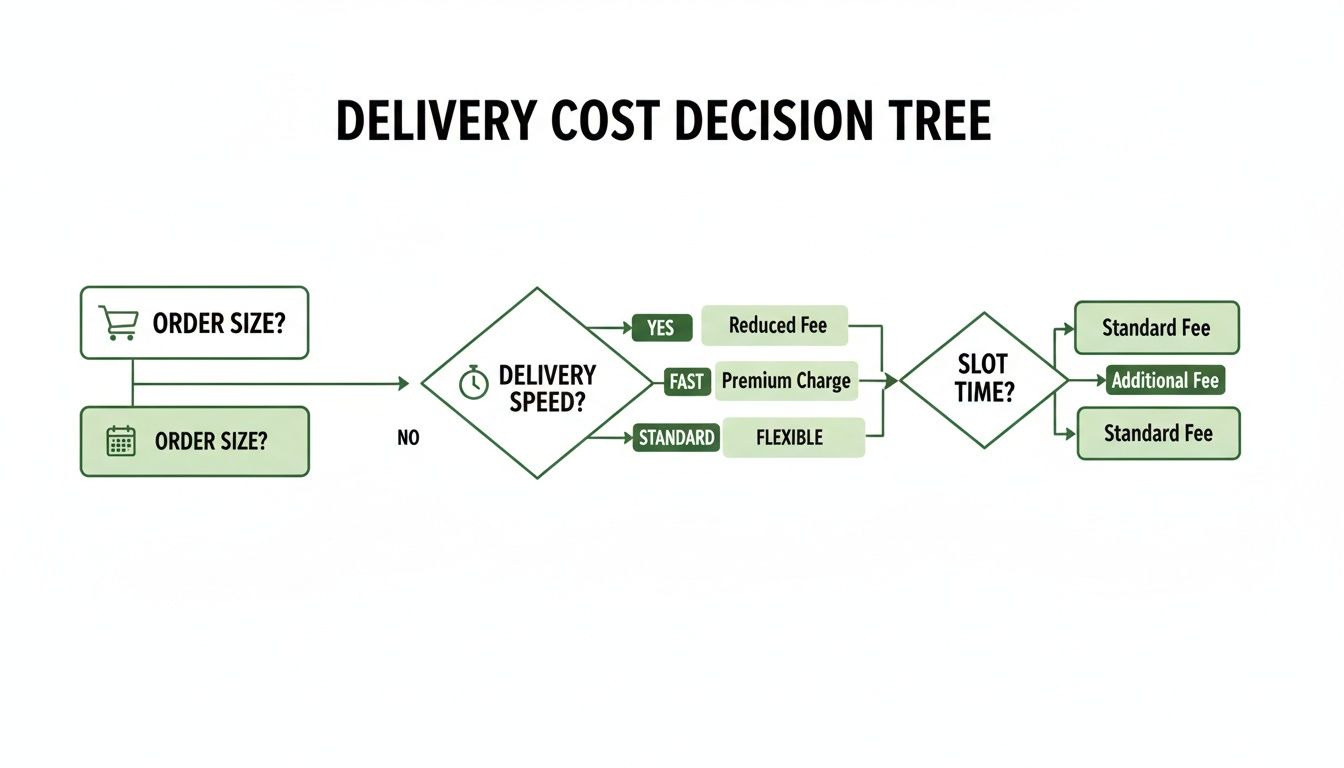
As you can see, hitting that $35 minimum is the first and most crucial step to keeping costs down, whether you're a member or just ordering one-off.
When you start adding up all those extra benefits, the math looks even better. If your family already pays for a streaming service or regularly fills up at one of their partner gas stations, the membership fee is practically paid for before you even place your first grocery order. Suddenly, it’s not just a delivery pass—it’s a savings tool for your whole household budget.
Surprise! Uncovering Surcharges and Hidden Costs
So, you’ve played the game perfectly. Your cart is full, you’ve smashed that $35 minimum, and you’ve even snagged a delivery slot with a reasonable fee. But then you get to the final checkout screen, and… wait a second. The total is a few bucks higher than you calculated. What gives?
Welcome to the wonderfully weird world of surcharges. Think of the main delivery fee as your ticket to the concert. The surcharges? They're the "convenience fee" for buying the ticket online, the extra charge for parking, and the ridiculously priced bottle of water. They aren't always there, but knowing they exist is half the battle.
The Driver Tip: It's Not Really "Optional"
First up, let's talk about the driver tip. Walmart’s app will tell you it’s optional, but let's be real—it’s a non-negotiable part of the deal if you want to be a good human.
Your driver is a gig worker, hustling to make a living, and tips are a huge chunk of their income. After your bags of precious cargo land on your doorstep, the app will nudge you to add a tip, usually suggesting something around 15%. Just plan for it. Consider it a built-in cost for the magic of not having to drag three kids through the cereal aisle. A good rule of thumb is to budget 15-20% of your order total, especially if you ordered a ton of stuff or it’s pouring rain outside.
Those Sneaky Little Add-On Fees
Beyond the tip, a few other gremlins can sneak onto your bill. While Walmart's own delivery service is pretty straightforward, it’s still smart to keep an eye out for these.
- Heavy Item Fees: Are you stocking up for the apocalypse with 10 cases of water and a 50-pound bag of dog food? Some services might tack on a small fee for orders that could throw out your driver’s back. It’s a heads-up that your order is a literal heavy lift.
- Price Differences: Is the online price the same as the in-store sticker price? With Walmart’s own platform, the answer is usually yes. But if you're using a third-party app, watch out. They sometimes mark up individual item prices to cover their own operational costs.
Here's the most important thing to remember: always, always, always review the final itemized bill before you hit that glorious "Place Order" button. That final screen is your last line of defense. A quick scan will tell you exactly how much Walmart charges for grocery delivery on that specific order, saving you from any budget-busting surprises later.
So, What About Instacart? A Head-to-Head Battle
Walmart isn't the only player in the grocery delivery game. The heavyweight champ of third-party shopping is Instacart, a platform that sends personal shoppers to all sorts of local stores for you—including Walmart in many areas.
So, how does Walmart’s in-house delivery service stack up against this giant? It’s not just about the final fee; it’s about the entire experience, from who picks your avocados to how you handle an out-of-stock item.
The main difference is who is doing the shopping. When you order from Walmart directly, a Walmart employee is on the case. With Instacart, a freelance shopper takes care of everything from start to finish. This one distinction creates two totally different worlds, especially when it comes to communication.
The Service Experience Showdown
One of the features people absolutely love about Instacart is the real-time chat with your personal shopper. If that specific brand of organic Greek yogurt is gone, your shopper can zap you a quick message with a photo of the alternatives. You get to make the final call right then and there.
This direct line of communication is a lifesaver for anyone who's particular about their groceries.
Walmart's system is much more automated. You can set your substitution preferences ahead of time (like "swap for a similar item" or "just refund me"), but there’s no real-time back-and-forth. It’s efficient, but you do lose a bit of control over the final haul.
It really comes down to your shopping style. Do you want a hands-on, communicative process (hello, Instacart), or do you prefer a streamlined, set-it-and-forget-it system (that’s Walmart)? There’s no wrong answer, just a personal preference.
Pricing Models and The Sneaky Markup
Okay, let's talk money. This is where things get really interesting. Both services offer a subscription to ditch delivery fees on qualifying orders: Walmart+ and Instacart+. They sound the same, but the devil is in the details—specifically, the price of each item.
Walmart’s own platform promises the same prices you'd find in the store. That’s a huge plus. What you see on the shelf is what you pay online.
Instacart, on the other hand, often has slight markups on individual items to cover its own costs. They aren't always massive, but those little bumps can definitely add up over a big weekly shop. We actually explored this in more detail in our Instacart vs. Amazon Fresh comparison, which gets into similar pricing games.
Walmart has been pouring resources into making its own service the cheaper choice. By getting smarter with things like packing more orders into a single delivery route, the company recently slashed its delivery costs per order by a whopping 40%! As this recent supply chain analysis points out, these behind-the-scenes efficiencies are meant to directly benefit your wallet, making Walmart's native service a tough competitor on price.
Feature Face-Off: Walmart Delivery vs. Instacart
So, which service truly wins for your family? It's not a simple answer, as each has its own strengths. Let's break it down feature by feature.
| Feature | Walmart Delivery | Instacart | Winner For... |
| Pricing | In-store prices guaranteed. | Often includes item markups. | Walmart: Budget-conscious shoppers. |
| Store Variety | Limited to Walmart stores. | Wide variety of local stores available. | Instacart: Shoppers who want options. |
| Shopper Interaction | Automated substitutions, no live chat. | Real-time chat with personal shopper. | Instacart: Those who need control over swaps. |
| Subscription | Walmart+ ($98/year) includes fuel perks. | Instacart+ ($99/year) offers credits on pickup. | Walmart: Families who can use the extra perks. |
| Delivery Speed | Standard and Express options available. | Priority options get groceries in <1 hour. | Instacart: Anyone in a last-minute pinch. |
Ultimately, Walmart is built for cost-conscious, loyal shoppers who value consistency. Instacart shines for its flexibility, variety, and the personal touch of a dedicated shopper. Deciding between them means figuring out which of those benefits is most important for your weekly grocery run.
Expert Tips to Reduce Your Delivery Bill
Alright, so you know how Walmart’s delivery fees work. That's half the battle. The other half? Making that number shrink until it’s barely a blip on your budget. With a few smart moves, you can turn those delivery fees from a weekly annoyance into a distant memory.
The single most powerful trick in the book is to batch your orders. Seriously. Stop placing tiny, frequent orders that keep dipping below that $35 minimum. Instead, plan your meals for the week, build one monster list, and hit "checkout" just once. This habit alone is your golden ticket to clearing the free delivery hurdle if you have Walmart+.
Master Your Timing and Planning
Beyond just what you buy, when you buy can make a surprising dent in your bill, especially if you're paying per delivery. Fees often wiggle up and down based on how busy they are.
- Schedule Off-Peak Deliveries: Think like a traffic ninja. A Tuesday morning is way less chaotic than a Friday evening, and the delivery fees often reflect that.
- Embrace Slower Delivery Windows: I get it, instant gratification is awesome. But not every grocery run is a five-alarm fire. Opting for a wider, less urgent delivery window can sometimes knock a few bucks off the price.
And let's be honest, Walmart is getting ridiculously fast. About a third of their deliveries land on the porch in 3 hours or less, and an incredible 20% of those show up in under 30 minutes. That's amazing, but unless you have Walmart+, that kind of speed usually comes with a premium price tag.
The key is to separate your "wants" from your "needs." If you don't truly need that ice cream in the next hour, choosing a standard delivery time is one of the easiest ways to keep more money in your pocket.
Hunt for Extra Savings
Okay, time to get tactical. Before you ever finalize that order, a few minutes of digital coupon-clipping can pay off big time.
First, always poke around for promotional codes or digital coupons right there in the Walmart app or on their site. They're constantly running deals that can chip away at your total.
Then, stack on the savings with cash-back apps or browser extensions. These little helpers can give you a percentage of your purchase back, which is basically like creating your own personal discount. Reducing your grocery bill is a fantastic first step, and if you're looking to cut costs across the board, you can find more great ideas on how to reduce monthly bills. For a deeper dive, check out our own guide on grocery delivery tips for seamless shopping.
Got Questions About Walmart Delivery? Let's Clear Things Up.
Still have a few questions floating around? You're not the only one. When you're trying to figure out exactly how much Walmart's delivery will cost, the little details can make a big difference. Let's get into the most common questions so you can place your next order like a pro.
So, Do I Really Have to Tip My Walmart Driver?
The app might say a tip is "optional," but let's be real—it's pretty essential for the drivers. These folks are gig workers, not full-time employees, and tips are a huge part of how they make a living. Once your groceries arrive, the app will prompt you to add a tip, and it’s a good idea to do so.
A solid starting point is 15-20% of your order total. I'd even suggest leaning towards the higher end if your driver was a lifesaver—think hauling a massive order up to your apartment or braving a downpour to get you your milk. It's a small way to say "thanks for saving me from that chaos."
What's the Magic Number for Free Delivery with Walmart+?
For Walmart+ members, the golden ticket to free delivery is a $35 order. Just make sure your cart hits that $35 subtotal before any taxes or fees are added.
Be careful with this one! If you’re a member and your order dips below that $35 mark, you'll get hit with a below-minimum fee, which is usually around $6.99. A smart move is to always plan your list to hit that minimum and make your membership worth every penny.
Can I Use My Paper Coupons on a Delivery Order?
This is a big one, and unfortunately, the answer is no. Walmart doesn't accept paper manufacturer coupons for any of their online grocery orders, whether it's for delivery or pickup.
But don't despair! You can still snag plenty of deals. Just head over to the "Savings" section on Walmart's website or in the app. They're always running digital coupons, Rollbacks, and other online-only promos that get applied to your cart automatically. It just takes a quick look before you check out.
---
Feeling like your week revolves around meal planning and grocery lists? It's a grind. With Meal Flow AI, you can get a custom meal plan in a few clicks and send the shopping list right over to Instacart. This means fewer, bigger orders and way fewer delivery fees. Stop the app-switching madness and actually enjoy your food. See how Meal Flow AI can make your life easier.