A Pro's Guide on How to Scale Recipes for Any Crowd Size
Learn how to scale recipes flawlessly. Our guide breaks down kitchen math, tricky ingredients, and pan sizes for perfect results when cooking for two or twenty.
Love This Article?
Get personalized meal plans with recipes like this, automatically matched to your nutrition targets.
We've all been there. You find a fantastic brownie recipe, decide to double it for a party, and end up with a pan of sad, gooey despair. Or you try to halve a soup recipe for a quiet night in, only to find it bland and watery. What gives?
It turns out that just multiplying every ingredient by two is one of the biggest myths in home cooking. And it's a trap I've fallen into more times than I'd like to admit.
The Art of Scaling Recipes Without Ruining Dinner
This simple math works for some things, but it can lead to total disaster with others. A dash of cayenne that provides a gentle warmth in a small batch becomes a five-alarm fire when you just double it. And don't even get me started on baking—those delicate chemical reactions rarely cooperate with basic multiplication.
Why Simple Math Fails in the Kitchen
The truth is, flavor and texture don't scale in a straight line. Our perception of saltiness, for instance, intensifies much more quickly than other flavors. If you double a recipe and double the salt, you’ll almost always end up with something that’s overwhelmingly salty.
This guide is your ticket out of that kitchen-fail cycle. We’re going to ditch the guesswork and get to know a little concept I call the scaling factor. Think of it as a simple multiplier that will quickly become your most reliable kitchen tool. It’s the first real step to scaling recipes with total confidence.
The goal isn't just to make more food. It's to replicate the original recipe's flavor, texture, and soul in a different quantity. True scaling preserves the very essence of the dish, no matter the pan size.
Mastering the Scaling Factor
The scaling factor is the simple calculation at the heart of every successful recipe conversion. It’s the bridge between the recipe you have and the meal you actually want to make.
Here's how you figure it out:
- Decide your desired servings: How many people are you feeding? Let's say you want to make 10 servings.
- Check the original recipe's yield: How many servings does it say it makes? Let’s assume it’s 4.
- Do the math: Divide your desired servings by the original servings.
In our example, that's 10 ÷ 4 = 2.5.
That number, 2.5, is your magic scaling factor. It's what you'll use to multiply most of your ingredients. This is so much more precise than just guessing or blindly doubling everything. It turns a vague idea like "I need more chili" into a clear, actionable plan.
Getting this basic principle down is everything. Once you have it, you can move on to the trickier parts—like how to handle spices, liquids, and leaveners, which we’ll get into next. This is how you go from just following a recipe to truly understanding the craft of cooking.
The Kitchen Math Your Recipes Can’t Live Without
Alright, let's get down to the brass tacks. This is the part of the process that separates a triumphant, crowd-pleasing meal from a tragic, soupy mess. Don't worry, you can put the graphing calculator away. This isn't high-level algebra; it's the simple, powerful math that will make you a more confident and consistent cook.
The first, and most important, concept is to ditch the scoop for the scale. I'm serious.
Think about the humble cup. While it feels easy, it’s a wildly inconsistent way to measure anything. Is your flour sifted or packed down? Is your brown sugar lumpy or fluffy? These little variations can absolutely wreck a recipe, especially in baking, where precision is everything. A simple digital kitchen scale is the single best tool you can buy to bring reliability to your cooking.
Your Magic Number: The Scaling Factor
Once you've embraced weighing your ingredients (and trust me, you will never go back), the next move is to find your scaling factor. This is the simple multiplier we talked about earlier that makes all the adjustments a breeze.
You only need two numbers to figure it out:
- Your Desired Servings: How many people you actually need to feed.
- The Original Recipe Yield: How many servings the recipe says it makes.
The formula is dead simple: Desired Servings ÷ Original Recipe Yield = Scaling Factor.
So, if you’ve got a chili recipe that serves 4, but you’re having 10 people over for game night, your math looks like this: 10 ÷ 4 = 2.5.
That number, 2.5, is your magic number. You’ll multiply the weight of your core ingredients by 2.5 to get your new amounts. Understanding how to calculate serving sizes is a key skill in itself, and our guide on the topic goes into even more detail.
Putting the Scaling Factor to Work
Let's run through a real-world scenario. Imagine you're making your family's favorite lasagna, which normally serves four. Then you get the text: guests are on their way, and your dinner party just doubled to eight. Your first instinct might be to just eyeball it and double everything, but that's where things can go wrong.
A much safer bet is to use the original recipe's yield as your base. If the recipe calls for 500g of pasta and 1kg of ground beef to serve four, you can quickly figure out the per-portion amounts: 125g of pasta and 250g of beef per person.
Now, just multiply by your new target of eight servings. You'll need 1,000g of pasta and 2,000g of beef. This simple math is the secret to consistency, and it's especially critical when you're using a tool like Meal Flow AI to automatically build an Instacart shopping list.
The real danger is trying to scale with cups and spoons. As food science experts at FoodCrumbles point out, a "cup" of flour can vary in weight by a shocking 20-25%. That's enough to turn a perfect cake into a dense brick when you try to scale it.
Scaling Cheat Sheet: Common Ingredient Conversions
To really drive home why weighing is king, take a look at how much a "cup" can vary. It’s a bit of an eye-opener!
| Ingredient | 1 Cup (Volume) | Approximate Weight (Grams) | Why Weight Matters |
| All-Purpose Flour | 1 Cup | ~120g | Sifted vs. packed can change this by up to 30g. |
| Granulated Sugar | 1 Cup | ~200g | Fairly consistent, but weight is still more precise. |
| Brown Sugar | 1 Cup, packed | ~220g | "Packed" is subjective. Weight is not. |
| Water/Milk | 1 Cup | ~240g | Liquids are the most consistent, but scales rule. |
| Chocolate Chips | 1 Cup | ~170g | Size and shape of chips creates air pockets. |
See what I mean? A cup is not a cup. This little chart is your first step toward breaking free from the tyranny of volumetric measurements and achieving pro-level consistency in your kitchen.
A Baker’s Secret Weapon: Baker’s Percentage
For all my fellow bakers out there who live for the perfect loaf of bread, cake, or pastry, there’s an even more powerful technique called baker’s percentage. Honestly, this method is a complete game-changer for getting repeatable results every single time.
Here's how it works: the total weight of the flour is always 100%. Every other ingredient—water, salt, yeast, you name it—is then calculated as a percentage of that flour weight.
For example, in a classic sourdough recipe, it might look like this:
Flour: 1000g (100%)
Water: 750g (75% hydration)
Salt: 20g (2%)
Starter: 200g (20%)
The beauty here is that scaling becomes foolproof. Want to make a smaller loaf? Just decide on a new flour weight—say, 500g. All the other ingredients adjust perfectly. Your water becomes 75% of 500g (375g), your salt becomes 2% of 500g (10g), and so on.
This is the standard in professional bakeries for a reason. It removes all the guesswork. Adopting this mindset, even for simpler recipes, will fundamentally change how you bake for the better.
Navigating the Nuances of Different Ingredients
Alright, this is where the real art comes in. You’ve nailed the basic math and wisely switched to weights, but now you’re getting into the nitty-gritty of how to actually scale a recipe. Not every ingredient plays by the same rules, and just blindly multiplying everything is a one-way ticket to a kitchen disaster.
Think of it this way: simply doubling the salt can turn a beautiful stew into a brackish nightmare. The same goes for potent spices like cayenne or cloves. Our taste buds just don't register these intense flavors in a straight line. What was a gentle, background warmth can suddenly become a five-alarm fire.
This flowchart shows you the core process: get everything out of those inconsistent cups and into reliable grams before you even think about grabbing a calculator.
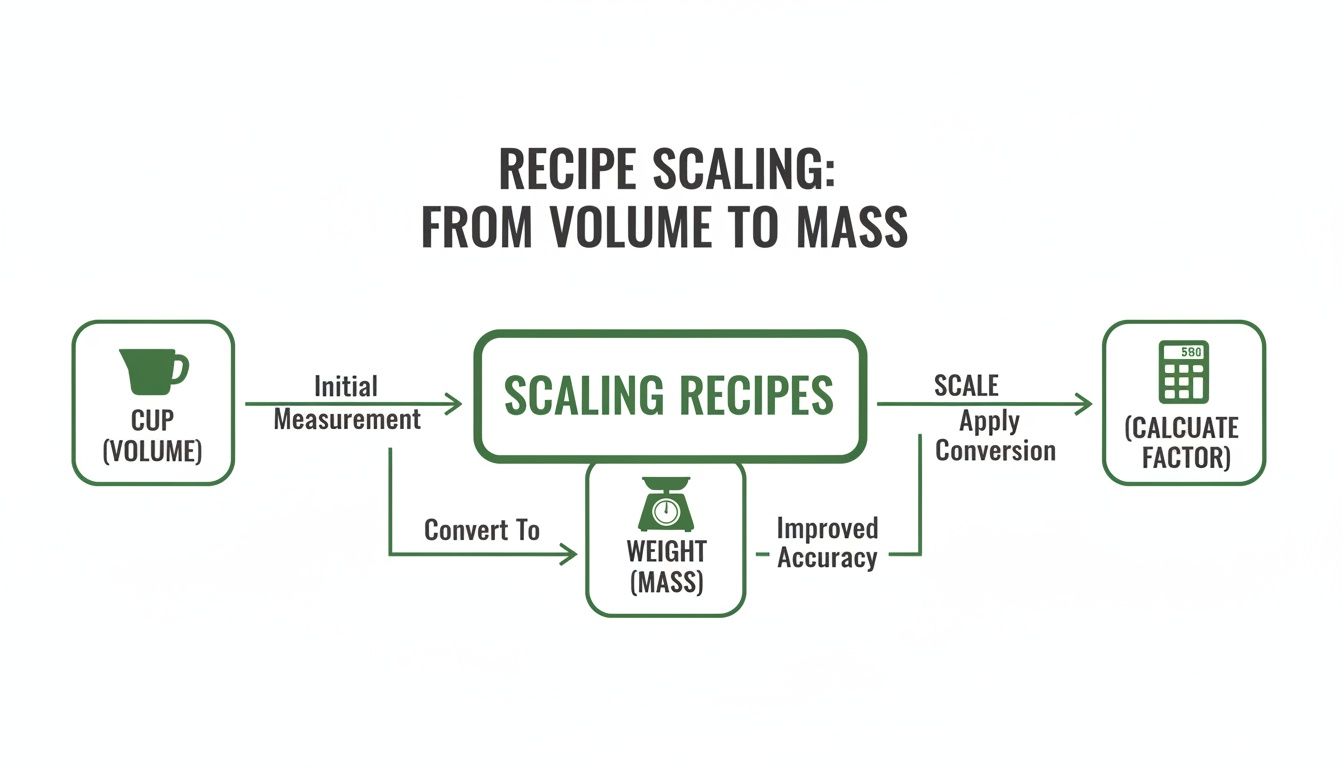
This is the absolute bedrock of successful scaling. Get this right, and you're already halfway to a perfect result.
Taming Your Spices and Seasonings
When you make a bigger batch of food, you don't always need a proportionally bigger punch from your seasonings. The relationship between surface area and volume changes, and that messes with how flavor gets distributed and how we taste it.
For salt and other heavy hitters, the golden rule is to start low and go slow.
Here’s my go-to strategy:
- Going Bigger: When I double a recipe, I only multiply the salt, dried herbs, and potent spices by 1.5 to start. If a 4-serving recipe needs 1 teaspoon of salt, the 8-serving version gets 1.5 teaspoons, not a full 2.
- Going Smaller: Halving a recipe is usually more forgiving. You can generally just divide these ingredients by 2. Just be careful—if you end up with a tiny, hard-to-measure amount, you might need to use slightly more than a direct half to avoid a bland dish.
Taste. Adjust. Repeat. I can't stress this enough. This is the single most important technique you have. Let the dish cook for a bit so the flavors can mingle, then give it a taste. You can always add more chili powder, but you can’t take it out once it’s in there.
The Science of Leavening Agents
Baking is pure chemistry, and ingredients like baking soda and baking powder are the catalysts. The problem is, their reactions don't scale up in a neat, linear way. Double the baking powder, and you risk a nasty chemical aftertaste or, even worse, a cake that rises dramatically only to collapse into a dense, sad crater.
It’s because the leavening reaction is more closely tied to the batter's surface area, which doesn't increase at the same rate as its total volume.
- Going Bigger: When doubling a recipe, I multiply leaveners by 1.25 to 1.5, max. So, if the original calls for 1 teaspoon of baking soda, the doubled batch gets 1.25 to 1.5 teaspoons.
- Going Smaller: Halving is much safer. You can typically divide your leavening agent by 2 without any drama. Just be super precise with your measurements!
Handling Liquids and Fats
Liquids, fats, and alcohol bring their own special brand of chaos to the party. Scaling up a recipe usually means you’re using a bigger pot or pan. A wider pot means more surface area, which means one thing: faster evaporation.
If you just double the broth in a soup, you could easily end up with a salty, over-reduced concentrate after it simmers. Understanding how your ingredients work is key. For example, knowing the smoke points and flavors of different olive oil types for cooking will help you maintain the right texture when you scale up.
The same goes for wine or other alcohols used for flavor—they'll reduce much differently in a giant saucepan.
- Going Bigger: When doubling liquids like stock or wine, I start by multiplying by around 1.75. I can always top it off later if the dish looks like it's drying out.
- Going Smaller: Halving liquids is pretty simple. Just divide by 2, but keep a close eye on it. A smaller volume can cook down much faster than you expect.
And don't forget about fresh vegetables! Their water content is a huge variable. Getting the hang of how to meal prep vegetables gives you a better intuition for how they behave and release moisture, which is invaluable knowledge when you're scaling recipes. This is how you go from just following a recipe to truly running your kitchen.
It’s Not Just the Ingredients—It’s the Hardware
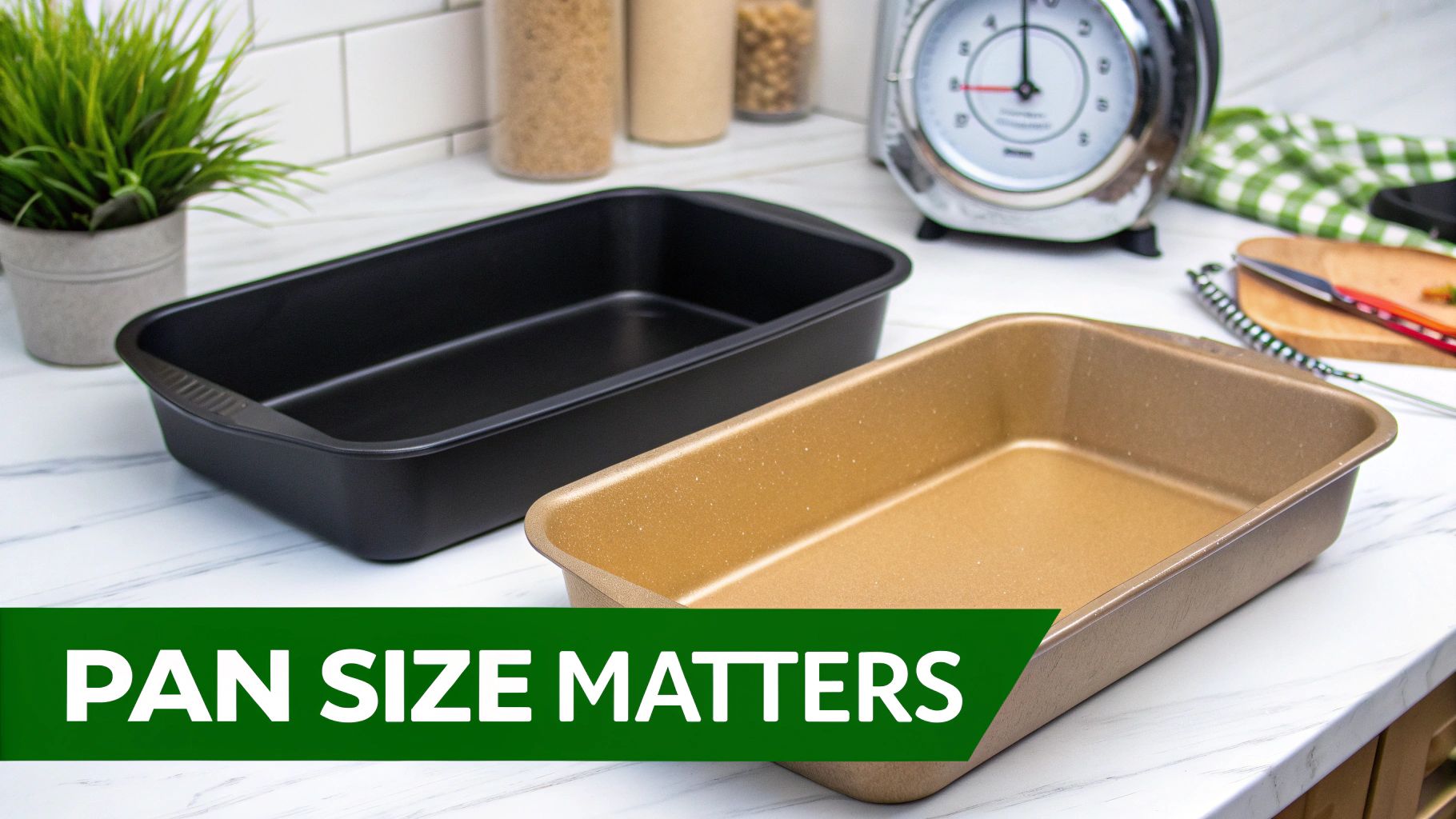
You did it. The math is done, the ingredients are measured, and your prep station looks like a work of art. But all that glorious effort can go straight down the drain if you ignore the one thing sitting right in front of you: your pan.
Trying to squeeze a doubled brownie recipe into the original 8x8 pan is a surefire way to create a culinary tragedy—a molten, raw center surrounded by burnt, rock-hard edges. Trust me, I've seen it happen.
Scaling a recipe is as much about physics as it is about food. The size, shape, and even the material of your pot or pan dictate how heat moves, how quickly moisture evaporates, and how your dish ultimately turns out. Get this part wrong, and you're in for a frustrating cook.
Finding the Right Pan for the Job
First things first: give your food some breathing room. Overcrowding a pan is a cardinal sin in the kitchen. It traps steam, kills any chance of a good sear, and ensures everything cooks unevenly.
Think about it—if you double a batch of roasted potatoes but cram them into the same sheet pan, they won't roast. They'll steam into a sad, soggy mess. Not exactly the crispy, golden-brown deliciousness you were hoping for.
The goal is to keep the depth of the food consistent. If the original brownie batter filled an 8x8 pan to a one-inch depth, your scaled-up version should sit at that same one-inch depth in a bigger pan. This maintains the cooking dynamics the recipe intended.
So, how do you pick the right pan? It all comes down to volume.
- Square/Rectangular Pans: Just multiply Length x Width x Height. An 8x8x2 inch pan gives you 128 cubic inches of space.
- Round Pans: The formula is π x (radius)² x Height. Or, you know, just Google an online "pan volume calculator" like the rest of us.
Let's say you double a recipe that fit perfectly in an 8x8 pan (which holds about 8 cups). You’ll need a pan with roughly double the volume. A classic 9x13 pan, holding around 14-15 cups, is usually the perfect upgrade.
Don't Double the Cook Time!
This is the big one. The mistake almost everyone makes. Doubling the recipe does not mean doubling the cooking time. If you take nothing else away, remember this. It's a one-way ticket to dry, overcooked food.
A bigger batch of food takes longer for heat to penetrate to the center, but the relationship isn't linear. A good starting point is to increase the original cook time by 25% to 50%.
If your lasagna normally bakes for 40 minutes, a double batch will likely need 50 to 60 minutes. This is where your senses—and an instant-read thermometer—become your best friends. Start checking early and often.
A pro tip for scaling up is to use progressive batch testing. When going from a small home batch to a much larger one, expect cooking times to extend by 20-30% due to the complex heat dynamics of a larger volume. You can learn more about these operational insights on Computrition's blog.
Sometimes, you even have to tweak the oven temperature. For a much larger cake, you might drop the temp by 25°F (about 15°C) and bake it longer. This gentle heat gives the center a chance to cook through before the edges turn into charcoal.
The Shallow vs. Deep Dilemma
The geometry of your pan completely changes the game. A wide, shallow pan has a massive surface area, which is fantastic for browning a casserole topping or reducing a sauce until it's perfectly thick. More surface area means faster evaporation.
On the flip side, a deeper, narrower pot with the same volume minimizes evaporation. This is exactly what you want for soups, stews, and braises where every drop of that precious liquid counts.
Using the wrong shape can turn a thick, hearty ragu into a watery soup. This is why your cookware is just as critical as your ingredients. Pay attention to your hardware—it makes all the difference.
Let AI Handle the Math with Meal Flow AI
Alright, so we’ve waded through the nitty-gritty of scaling recipes by hand. You've got the conversion math down, you know the quirky rules for different ingredients, and you’re ready to eyeball pan sizes. It's a fantastic skill to have in your back pocket.
But let’s be real. On a busy Tuesday night when you just want to get dinner on the table, who wants to be a human calculator?
What if you could just… not do the math? Imagine a little kitchen helper that handles all those tedious conversions and calculations for you, applying all the nuanced rules we just talked about. That’s where things get really fun.
Your Personal Sous-Chef for Recipe Scaling
This is exactly what we built Meal Flow AI to do. Think of it as your digital sous-chef, ready to intelligently rescale any recipe you give it, instantly. No more scribbling fractions on a sticky note or wondering if you’ve added way too much baking powder.
Just drop in your favorite recipe—let's say it's Grandma's legendary spaghetti sauce that serves six. Then, just tell the app how many people you're actually feeding tonight, whether it’s a cozy dinner for two or a party of twelve.
The platform gets to work right away. But here’s the key: it doesn’t just blindly multiply everything. It uses the same smart scaling logic a seasoned chef would. If you're curious about how this kind of automation works under the hood, this practical guide to using AI in spreadsheets offers a fascinating peek into building these kinds of adjustments from scratch.
Here's a look at the interface. You can literally just slide to adjust your serving size.
See how the ingredient amounts change in real time? All the guesswork is just… gone.
Smart Adjustments for Foolproof Results
Meal Flow AI is more than a simple calculator. It’s been programmed with the specific culinary rules needed to get consistently delicious results, automatically sidestepping the most common scaling disasters.
- Spices and Salt: The AI knows better than to double the salt just because you doubled the recipe. It applies a more conservative 1.5x multiplier, saving your dish from becoming a salt bomb.
- Leavening Agents: When it comes to baking, it respects the chemistry. It’ll adjust baking soda and powder much more carefully, so you don’t get a weird chemical aftertaste or a cake that collapses on itself.
- Pan Size Suggestions: It even thinks about your equipment. If you triple a casserole recipe, it’ll probably suggest swapping your 8x8 pan for a 9x13 to make sure everything cooks through evenly.
This intelligent approach gives you the reliability of a well-tested recipe, no matter how big or small your final batch is. It's the perfect mash-up of cooking science and modern tech, designed to make your kitchen life easier. Our deep dive on choosing the right meal planner software shows how features like this can literally give you hours back each week.
From Scaled Recipe to Shopping List in a Click
Now for my favorite part. Once your recipe is scaled perfectly, you’ve got a precise list of what you need. But you still have to go get it all.
Meal Flow AI connects the dots beautifully. With one click, it turns that perfectly scaled recipe into a ready-to-order Instacart shopping list.
This integration is an absolute game-changer. It gets rid of manual list-making, stops you from over- or under-buying ingredients, and seriously cuts down on food waste. What used to be three separate chores—scaling, writing a list, and shopping—is now one smooth, simple action.
Think about planning a big holiday meal. You can scale five different recipes to serve fifteen people, and the AI will crunch all the numbers, consolidating everything into a single, organized shopping list—from 4.5 pounds of chicken down to the 3 tablespoons of paprika.
This is what modern home cooking can be: less time spent on boring tasks and more time actually enjoying the creative process and, of course, eating the delicious food. It completely removes the stress from scaling recipes and replaces it with pure confidence.
Your Recipe Scaling Questions Answered
When you start fiddling with recipe sizes, a few questions always seem to surface. Consider this your official FAQ for avoiding kitchen disasters. We've tackled the most common head-scratchers to get you back to cooking with confidence.
Can I Really Scale Any Recipe?
Heck no. And anyone who tells you otherwise is setting you up for failure.
The good news is that most savory dishes are incredibly flexible. Think soups, stews, chilis, and hearty casseroles—they're practically begging to be doubled for a party or cut in half for a quiet night in. You can play fast and loose with these and usually come out on top.
But then there's baking. Delicate recipes like soufflés, meringues, and angel food cakes are pure chemistry. Their light, airy magic depends on an exact balance of ingredients, and that science simply doesn't scale in a straight line. If you try to make one giant batch, you'll likely end up with a dense, rubbery mess.
For those sensitive recipes, your best bet is to make multiple separate batches. If you're ever on the fence about a new recipe, a good rule of thumb is to start by scaling it by no more than double or half. It’s a low-risk test run that’ll show you how the recipe behaves before you commit a mountain of ingredients.
What Do I Do with Awkward Numbers Like 1.5?
This is the moment your digital kitchen scale puts on a cape and becomes your hero. Eyeballing 1.5 tablespoons is a fool's errand, but multiplying grams? That's clean, simple, and beautifully precise. The trick is to convert everything to weight before you do any math.
Let's say a recipe calls for 1 cup of flour (125g) and 2 tablespoons of sugar (25g). If you need to scale it by 1.5, the math is a breeze:
- Flour: 125g x 1.5 = 187.5g
- Sugar: 25g x 1.5 = 37.5g
Your scale laughs in the face of decimals, giving you perfect accuracy and banishing all the guesswork.
But what about the dreaded egg fraction? If your math spits out 1.5 eggs, don't panic. Just whisk two whole eggs in a small bowl, weigh the total (a large egg is about 50g, so two is roughly 100g), and then pour out half (50g) for your recipe. Problem solved.
What's the Biggest Mistake People Make?
Oh, this one's easy. It's blindly multiplying every single ingredient by the same number. This is a one-way ticket to disaster, especially with salt, potent spices (like cayenne or cloves), and leavening agents.
Your taste buds don't experience saltiness in a straight line. Doubling the salt just because you doubled the recipe is the fastest way to make an inedible, salty brick you’ve spent hours on.
A much smarter move is to multiply your salt by only 1.5 when you double everything else. From there, you can taste as you go and add more only if it truly needs it. The same goes for baking powder and baking soda—too much will leave a nasty chemical aftertaste and give your baked goods a bizarre texture.
The second-biggest blunder? Forgetting to change your pan size and adjust the cooking time. This is how you get the classic brownie tragedy: rock-hard, burnt edges protecting a raw, soupy middle. Give your food the space it needs to cook evenly and keep a close eye on it—it’ll likely need more (or less) time in the oven.
---
Tired of doing math on a flour-dusted calculator? Meal Flow AI intelligently scales any recipe for you, automatically handling the tricky ingredients and creating a ready-to-order Instacart shopping list in seconds. Give it a try for free and make your next meal foolproof!