The Meal Planner And Grocery List App To End Kitchen Chaos
Discover how a meal planner and grocery list app can save you time and money. Our guide reveals the features that transform meal prep from a chore to a breeze.
Love This Article?
Get personalized meal plans with recipes like this, automatically matched to your nutrition targets.
So, what exactly is a meal planner and grocery list app? Think of it as your secret weapon against the daily "what's for dinner?" panic. It’s a digital sidekick that helps you map out your family's meals for the week and then—here's the best part—automatically generates a shopping list from those recipes. No more frantic dashes to the store for a forgotten onion.
Your Secret Weapon Against Kitchen Chaos
Let’s be real. It’s 5 PM on a Tuesday. The kids are cranky, you’re exhausted, and staring into the fridge feels like a high-stakes guessing game. We’ve all been there. That daily grind of decision fatigue is exactly what a meal planner and grocery list app is designed to eliminate.
Forget seeing it as just another app on your phone; this is your personal kitchen strategist. It goes way beyond a simple digital recipe book. A truly great app lets you build a full week of meals that your family will actually eat, all while factoring in their unique tastes and any dietary restrictions.
From Plan to Pantry Without the Headaches
The real magic kicks in once you’ve picked your meals. The app scans every recipe and instantly whips up a perfectly organized grocery list. It accounts for every last sprig of parsley and pinch of paprika, so you'll never again have that sinking feeling of starting a dish only to realize you're missing a key ingredient.
This guide is your roadmap to turning the dreaded dinner dilemma into a solved problem. We'll dive into the features that save you time and money and show how next-level tools like Meal Flow AI are changing the game entirely.
By linking your meal plan directly to your shopping list, these apps create a smooth, logical flow from kitchen counter to grocery aisle. They bring a little bit of order to the beautiful chaos of family life, making grocery trips quicker and cooking way more fun. This is your first step toward a calmer, more organized kitchen.
How a Meal Planner and Grocery List App Really Works
Ever peeked behind the curtain to see how a great meal planner and grocery list app actually does its thing? It’s not some dark magic; it’s more like having a tiny, hyper-organized sous chef living in your phone, working for you 24/7. At its core, the app is a clever database that connects the dots between recipes, the ingredients they need, and your shopping list.
It all starts when you pick out your meals for the week. You can scroll through a massive library of recipes the app provides, but the real game-changer is being able to add your own. That handwritten lasagna recipe from Grandma? It can finally live in the same place as that trendy TikTok pasta you wanted to try.
Once you’ve tagged your meals, the app's little "assistant" gets to work. It meticulously scans each recipe, pulling out every single ingredient and how much you need. One cup of flour, two cloves of garlic, a tablespoon of olive oil—it all gets logged on a master list for the week.
The Smart Leap from Recipe to Grocery Aisle
This is where the serious time-saving kicks in. Instead of just dumping a jumbled list of 50 ingredients on you, a smart app does something brilliant: it cross-checks everything with your digital pantry. This is a handy feature where you tell the app what you already have on hand.
The app basically thinks, "Okay, the chili needs two onions and the stir-fry needs one, but you’ve already got one in the pantry. Cool, I'll just add two to the list." This ridiculously simple step is what stops you from coming home with a third jar of paprika when two are already hiding in the back of your cabinet.
This little diagram shows exactly how the app takes you from total kitchen chaos to a clear, organized plan.
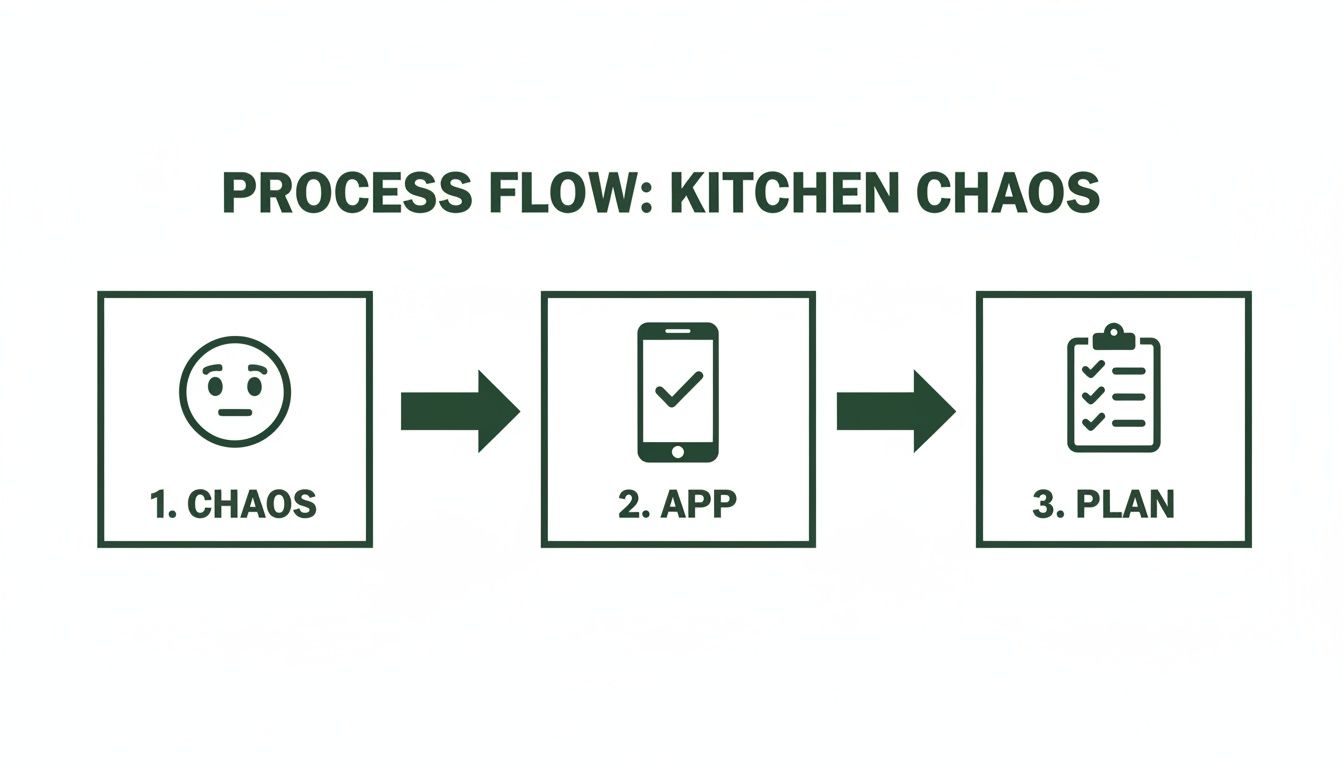
What you get in the end is a squeaky-clean, consolidated grocery list with only the stuff you actually need to buy. No more guessing games in the middle of the store and no more wasted money on stuff you already have. The best apps even sort this list by aisle (produce, dairy, canned goods) to turn your grocery run into a lightning-fast surgical strike.
Taking It to the Next Level with Artificial Intelligence
Standard apps are fantastic, but AI-powered platforms like Meal Flow AI are playing a completely different sport. An AI doesn't just follow your commands; it learns from them. It starts to notice the little things, the patterns in what you choose.
A regular app is like a calculator—it spits out the right answer when you punch in the numbers. An AI-powered app is more like a personal stylist—it learns your taste and starts suggesting outfits you'll absolutely love.
After a little while, the app can start making some seriously smart suggestions tailored to your family. It might see you cook chicken three times a week and slide a few new, exciting chicken recipes your way. Or, if you’re always picking 30-minute meals, it will learn to surface quick-and-easy options on your busiest nights.
The whole thing boils down to a few simple, powerful steps:
- Pick Your Meals: You either choose your recipes for the week or let the AI suggest a plan based on your past favorites.
- Ingredients Assemble!: The app automatically yanks all the ingredients from those recipes into one big list.
- Pantry Check: It then instantly subtracts anything you’ve told it you already have at home.
- The Perfect List: You’re handed a beautifully organized shopping list with only the items you need to buy.
This automated flow is the engine that makes these apps so incredibly handy. It’s what shrinks hours of painful planning into just a few taps on your screen. And when you sprinkle in some AI, the whole process becomes not just automatic, but truly personal and predictive, making life that much easier.
The Features That Separate a Good App From a Great One
Let's be real—not every meal planner and grocery list app is created equal. Some are basically just glorified digital notepads. Others? They're full-on kitchen command centers that practically wear a cape. If you’re serious about reclaiming your time and sanity, you need to know what separates the basic apps from the truly brilliant ones.
Think of it like choosing a car. A basic model gets you from A to B, no problem. But a great one has smart navigation that dodges traffic, adaptive cruise control, and seats that magically remember how you like them. The same idea applies here. The best apps don't just follow your commands; they anticipate your needs and automate all the boring stuff for you.
Deep and Meaningful Personalization
A great app doesn't just store your recipes; it actually gets to know you. It starts to learn your family's rhythm—that you’re all about tacos on Tuesdays, that one of your kids thinks broccoli is the enemy, and that you're trying to sneak more fish into your diet.
This is the kind of personalization that matters. It lets the app suggest meals your family will actually eat, not just random recipes pulled from a massive, impersonal database. The best apps go a step further and help you create a personalized nutrition plan, turning a simple tool into a genuine partner in your kitchen.
Robust Dietary and Allergy Filters
For so many of us, dietary needs aren't a preference; they're a non-negotiable part of life. A top-tier app needs powerful, reliable filters that go way beyond a simple "vegetarian" checkbox.
You should be able to plug in your family’s unique needs and trust the results completely.
- Allergies: Instantly banish nuts, shellfish, dairy, or gluten from all recipe suggestions. No more double-checking.
- Dietary Lifestyles: Whether you're Keto, Paleo, or Vegan, the app should serve up perfect recipes without you having to second-guess every ingredient.
- Ingredient Aversions: You can finally tell someone that your entire family despises cilantro, and the app will listen, steering clear of it forever.
This isn't just a "nice-to-have" feature. It's a massive stress reducer that makes mealtime safe and enjoyable for everyone at the table.
Smart Pantry Tracking That Actually Saves You Money
How many times have you bought a can of crushed tomatoes, only to get home and find three of them hiding in the back of the pantry? This is where a smart pantry tracker becomes your secret weapon against wasted money.
A great app lets you keep a running tab of what you already have on hand. When it builds your weekly grocery list, it automatically checks your digital pantry and crosses off anything you don't need. This one feature is a game-changer for preventing food waste and overspending.
Key Takeaway: A great meal planner doesn't just manage future meals; it intelligently manages the food you already own, preventing waste and saving you real money on every grocery trip.
The Ultimate Feature: Seamless Instacart Integration
Alright, here it is—the single most powerful feature that defines a modern, top-tier meal planner and grocery list app. Picture this: you tap a few buttons to finalize your weekly meal plan. The app instantly generates a perfect, pantry-checked grocery list. Then, with one more glorious tap, that entire list zips over to your Instacart cart, ready for checkout and delivery.
This is the holy grail of kitchen automation. It's pure magic.
It closes the entire loop, taking you from "Ugh, what's for dinner?" to "Your groceries are on the porch" without you ever having to leave the app (or put on real pants). This seamless connection, which is a core part of how Meal Flow AI works, eliminates the most soul-crushing part of the whole process: the actual shopping trip. If you want to dive deeper into what makes a tool like this tick, check out our complete guide to meal planner software.
This isn't just about bells and whistles; it's about making your life easier in a tangible way. To show you what I mean, let's compare what you get with a standard app versus a more advanced AI-powered one.
Comparing Standard vs. Advanced App Features
Most apps on the market offer a basic set of tools, which is a good start. But advanced platforms use AI to take things to a whole new level of convenience.
| Feature | Standard App | Advanced AI App (like Meal Flow AI) |
| Meal Planning | Manually add or search for recipes. | AI-generated weekly plans based on your tastes, diet, and schedule. |
| Grocery List Generation | Creates a list from the recipes you choose. | Automatically generates a categorized list and checks it against your pantry. |
| Pantry Tracking | Manual entry of items you have at home. | "Smart" pantry automatically deducts items as you use them. |
| Shopping Integration | Lets you manually export or copy your list. | One-click, direct integration that sends your list to an Instacart cart. |
| Personalization | You can save favorite recipes. | Learns your family's preferences over time and makes smarter suggestions. |
| Dietary Filters | Basic filters like "vegetarian" or "gluten-free." | Handles complex combinations of allergies, diets, and ingredient dislikes. |
As you can see, the difference is automation. A standard app requires you to do a lot of the heavy lifting, while an advanced AI app does it for you.
So, when you're looking for an app, keep this checklist in mind: deep personalization, rock-solid dietary filters, smart pantry tracking, and that all-important Instacart integration. Find a tool that nails all four, and you haven't just found an app—you've found a true partner for your kitchen.
A Week In The Life With an Automated Meal Plan
Okay, the theory is nice, but what does using a smart meal planner and grocery list app actually feel like on a chaotic Tuesday night? To really get it, let's follow Sarah, a busy mom who just brought Meal Flow AI on board to tame her family's kitchen chaos.

It’s Sunday night. This used to be Sarah's most dreaded hour—the "decision fatigue" zone, where she’d find herself doom-scrolling through Pinterest boards and dusty cookbooks. Not anymore.
Tonight, she just opens Meal Flow AI. During the initial setup, she gave it the lowdown: her family of four is obsessed with Mexican food, her son has a serious nut allergy, and Wednesday nights are a mad dash thanks to soccer practice.
Crafting The Perfect Plan in Minutes
With a single tap, the AI pops out a balanced weekly menu. It gets her family's vibe, automatically slotting in "Taco Tuesday" and scheduling a super-quick, 20-minute pasta dish for that hectic Wednesday. Better yet, it scrubs any and all recipes containing nuts, giving Sarah some much-needed peace of mind.
She glances over the plan, spots a chicken stir-fry for Thursday that looks incredible, and swaps it in with a drag and a drop. The entire plan for the week? Done in less than five minutes. This is a chore that used to suck up nearly an hour of her precious Sunday evening.
This is exactly why the meal planning app market has blown up. In 2023, the global market was already valued between $1.2 billion and $2.5 billion, and experts predict it’ll surge to $3.6 billion by 2032. This growth isn't just random; it's fueled by families just like Sarah's—a demographic that makes up 35-40% of users—who are tired of the chaos and want to prioritize both health and convenience. You can discover more insights about the meal planning app market growth if you're curious.
From Digital Plan To Front Door Delivery
Now for the part that feels like actual magic. Instead of grabbing a pen and paper to scribble down a long grocery list, Sarah just taps the "Create Grocery List" button. Instantly, Meal Flow AI zips through all seven dinner recipes and compiles every last ingredient.
But it gets smarter. The app cross-references this master list with her digital pantry, where she’d already noted having olive oil, onions, and rice. Like a perfect assistant, it intelligently removes those items from her shopping list, guaranteeing she doesn’t buy what she already has.
The result is a perfectly optimized, aisle-sorted shopping list that contains only what she truly needs. This one simple step is Sarah's secret weapon against food waste and those sneaky impulse buys.
Her final move is the real game-changer. She taps "Send to Instacart." The whole organized grocery list flies over and populates her Instacart cart. She gives it a quick once-over, adds a couple of household staples like paper towels, and hits "place order." Just like that, her week's groceries are scheduled to land on her doorstep Monday afternoon.
The Real-World Impact
So what did all this really do for Sarah in just one week?
- Time Saved: She got her Sunday night back (over an hour) and completely dodged the 90-minute grocery store ordeal. That’s a whopping 2.5 hours back in her pocket.
- Money Saved: Sticking to the precise list meant she sidestepped the usual impulse grabs—that tempting bag of chips, the fancy cheese, the extra box of cookies. This easily saved her $30-$40 on a single shopping trip.
- Stress Relieved: That constant, nagging hum of "what's for dinner?" is just... gone. She has a plan. She has the ingredients. And she walks into the kitchen feeling confident, not defeated.
This is what using a modern meal planner and grocery list app is all about. It’s not just a digital recipe box; it’s the command center for a well-run home. For Sarah, it turned a week of stressful scrambles into one of smooth, delicious success.
Why Smart Meal Planning Is A Budget Game Changer
Let's be honest, a smart meal planner and grocery list app isn't just about saving your sanity—it's one of the best-kept secrets for getting a death grip on your food budget. Stop thinking of it as just a digital recipe box. It’s more like a financial advisor for your kitchen, and its sole mission is to hunt down and eliminate the three biggest cash vampires lurking in your grocery habits.
First up: the impulse buy. We've all been there. You walk into the grocery store for milk and bread and walk out $100 poorer with a cart full of stuff you didn't need. A good app turns your shopping trip from a casual, expensive stroll into a surgical strike. You go in with a mission-critical list, grab exactly what you need, and get out before those shiny end-cap displays can whisper sweet nothings to your wallet.
Next, it declares war on food waste. A great app that knows what’s in your pantry stops you from buying a third bottle of ketchup when you already have two hiding behind the oatmeal. It transforms your pantry from a sad food graveyard into an efficient, money-saving machine.
Slashing Your Spending One Meal At A Time
The third, and maybe biggest, win is killing those last-minute, "I'm too tired to cook" takeout orders. When you have a plan and the ingredients are ready to go, the siren song of a $50 pizza order suddenly loses its power. And trust me, those savings stack up ridiculously fast.
Let's run some quick numbers. Say you stop just one $40 impulse-fueled grocery run and dodge one $50 takeout night each month. Boom. That's an instant $90 back in your pocket. Over a year, you've saved $1,080 without even trying. Our own guide on how to meal plan on a budget digs into even more ways to shrink that grocery bill.
A meal planning app isn't an expense; it's a high-return investment. The tiny subscription fee is usually paid for within the first couple of weeks, just from smarter shopping and tossing out less food.
It’s no surprise these tools are taking off, especially in the U.S. where busy lifestyles and tech just click. North America is the king of the meal planning app world, holding a massive 34-34.87% global share in 2023-2024. Health-conscious families with smartphones are the driving force, making features like AI recipe suggestions and automatic Instacart lists a perfect match for our hectic lives.
Advanced Budgeting with Smart AI
Tools like Meal Flow AI are built to take these savings to the next level. The AI is genuinely budget-aware. It crafts shopping lists that line up with standard package sizes, so you aren’t left with half a bunch of wilting celery in your crisper drawer.
The direct Instacart integration is another huge win for your wallet. It lets you compare prices right inside the app, so you can see where the deals are without having to juggle a dozen different browser tabs. If you're ready to really transform your grocery spending, you need to learn how to master budget-friendly meal planning for good. By taking over these small but crucial financial decisions, the app becomes your personal accountant, working 24/7 to keep your grocery bill on a tight leash.
The Future Is AI-Powered Meal Planning
Welcome to the next big thing in running your kitchen. If the meal planning apps you're used to are like a trusty old recipe binder, think of an AI-powered platform as your own personal chef—one who knows every single one of your family's quirks and cravings. This is where the simple meal planner and grocery list app gets a serious upgrade.
This leap forward is all about the app learning to think ahead for you. A basic app just does what you tell it. An AI-driven planner, on the other hand, actually pays attention. It starts to notice that you lean towards quick, 30-minute meals on hectic weeknights. It picks up on your family's deep love for anything Italian. It even gets that you're trying to sneak more veggies onto everyone's plates.
Instead of just sitting there waiting for you to do all the work, it uses what it learns to suggest meals you'll actually want to cook and, more importantly, have time for. That shift—from a passive tool to an active kitchen assistant—is changing the game for home cooks. The market for these smart tools is absolutely booming, set to skyrocket from $972.1 million in 2024 to an estimated $11.6 billion by 2034. That's a massive 28.1% growth spurt, which just goes to show how much families are crying out for smarter ways to manage mealtime. You can dig into the numbers in these AI-driven meal planning apps market trends.
Intelligent Automation That Actually Saves You Time
The real magic here isn't just about getting better recipe ideas. It's about how an AI can completely automate the most mind-numbing parts of the process. Let's be honest, the hardest part of meal planning isn't picking out what to eat—it's the mental acrobatics it takes to turn those recipes into a grocery list that doesn't miss anything.
An AI handles that whole mess for you. It doesn't just spit out a list; it makes it a smart list.
- Pantry Awareness: It already knows you have a bag of rice and plenty of onions, so it won’t tell you to buy more.
- Recipe Consolidation: Making three different recipes that all call for diced tomatoes? It combines them so you buy one big can instead of three little ones.
- Instacart Integration: With a single click, it sends that perfectly polished list right into your Instacart cart. Done.
This is the heart of what a platform like Meal Flow AI was built to do. It’s not just throwing ideas at you; it’s taking on the heavy lifting so you don't have to. You can see exactly how it works in our guide to the best AI meal plan generator.
From Idea to Dinner With Zero Friction
Picture this: the entire process, from the dreaded "What's for dinner?" to a hot meal on the table, feels easy. That's the whole point. The AI isn't just a fancy feature; it's the brain connecting every single step.
An AI meal planner doesn’t just give you a map; it offers to drive you there. It anticipates the traffic, knows the best shortcuts, and makes sure you arrive at your destination—a delicious, home-cooked meal—without any of the usual stress.
This kind of smart automation feels less like using an app and more like having a chat with a helpful assistant who already gets what you need. It’s about taking the mental load off your shoulders so you can get back to the fun part of cooking, not the endless prep work. This isn't some far-off futuristic idea anymore—it's the new normal for running a modern kitchen.
Got Questions About Meal Planning Apps? We've Got Answers.
Jumping into a new meal planner app can feel a bit like trying to assemble IKEA furniture without the instructions. You know the end result will be amazing, but a few questions always pop up along the way. Let's tackle some of the big ones so you can get planning.
Can I Add My Own Family Recipes?
You bet. And honestly, if an app didn't let you do this, you should run in the other direction. A good meal planner knows that your Aunt Carol's legendary lasagna recipe is non-negotiable.
Great apps like Meal Flow AI are designed for real-world kitchens. You can easily plug in your own recipes by pasting a link from your favorite food blog or just typing them in from that stained, handwritten recipe card. This way, all your family’s must-have meals are right there in the mix, and their ingredients automatically land on your grocery list. No classic dish gets left behind.
How Do These Apps Handle Dietary Restrictions or Allergies?
This is where a truly smart app goes from being a neat gadget to your most valuable kitchen assistant. The best ones have powerful filtering systems that go way beyond a simple "vegetarian" checkbox.
When you're setting things up, you can get super specific about what your family can and can't eat.
- Serious Allergies like peanuts, shellfish, or gluten.
- Dietary Preferences like keto, vegan, or low-carb.
- And Yes, Even Picky Eaters! Finally, an easy way to make sure broccoli never darkens your doorstep again.
The app's AI then becomes your personal recipe bouncer, only letting in meals that fit your family’s exact needs. It completely takes the mental load of double-checking every single ingredient off your plate.
Here's the bottom line: A great app doesn't just organize meals; it manages your family's unique dietary map. It's about getting back your peace of mind and knowing every meal you plan is a safe one.
Is an AI Meal Planner Going to Be Complicated to Use?
Nope! It’s actually built to be the exact opposite. Think of it less like a new piece of complex software and more like a personal assistant who just gets it. The whole point of the AI is to do the heavy lifting for you.
Platforms like Meal Flow AI are designed to make your life simpler. The setup is quick—just a few questions about your tastes and you're off. After that, the experience is clean and intuitive, guiding you from picking meals to checking out your groceries in a few clicks. The goal is to reduce your mental clutter, not add to it.
---
Ready to let technology handle the dinner dilemma? Meal Flow AI uses smart AI to build your perfect weekly meal plan and sends the grocery list straight to Instacart automatically. Get started with Meal Flow AI today and see just how simple mealtime can be.