Your Ultimate Meal Planning Grocery List to Save Time and Money
Tired of chaotic shopping trips? Master the art of creating a meal planning grocery list that slashes waste, cuts costs, and simplifies your life for good.
Love This Article?
Get personalized meal plans with recipes like this, automatically matched to your nutrition targets.
A meal planning grocery list is your secret weapon against overspending and those chaotic, last-minute trips to the store. Think of it as a detailed battle plan for your week's meals—a list you build after you’ve decided what you're eating and peeked into your pantry. This simple shift turns grocery shopping from a guessing game into a quick, money-saving mission.
Goodbye Grocery Chaos, Hello Smart Meal Planning
Let's be real for a second. The weekly grocery run often feels like a wrestling match between your good intentions and a cart full of impulse buys. The end result? Forgotten items and a receipt that makes you wince.
We’re done with that. It’s time to ditch the frantic, back-of-the-envelope scribbles for a system that feels less like a chore and more like a superpower for your week. A strategic grocery list is the essential link between your meal plan and a kitchen that actually works for you. Forget generic advice; we're getting into the nitty-gritty of what actually works for busy people.
The True Price of a Bad List
Wandering into the grocery store without a plan is like handing your wallet over at the door. You grab things you think you might need, completely forget the one crucial ingredient for Tuesday’s dinner, and end up with a hodgepodge of stuff that doesn't add up to a single meal. This chaos leads to more trips to the store, more wasted food, and a whole lot of frustration.
The goal here is simple: shift from reactive, panicked shopping to proactive, confident planning. A well-crafted list isn't just about what you buy—it's about taking back your time, your money, and your sanity. Diving into budget-friendly meal planning is the first step toward that financial peace of mind.
A great meal planning grocery list does more than just guide your shopping—it enforces your budget, slashes food waste, and frees up your mental energy for more important things.
Look at the difference a solid plan makes. It’s not just about organization; it's about fundamentally changing your relationship with food shopping.
The Strategic Grocery List Transformation
| Pain Point | The Old Way (No Plan) | The New Way (Strategic List) |
| Budgeting | "Wing it" and hope for the best. Easily overspend by 20-30%. | Stick to a pre-set budget. Only buy what's on the list. |
| Time Spent | Multiple trips per week, aimless wandering in every aisle. | One efficient trip. Navigate the store with purpose. |
| Food Waste | Produce wilts, "mystery meat" in the freezer. | Every item has a purpose. Minimal to zero food waste. |
| Mealtime Stress | "What's for dinner?" panic at 5 PM. Missing key ingredients. | Meals are planned, ingredients are ready. Stress-free cooking. |
| Impulse Buys | The snack aisle is your danger zone. | Laser-focused on the list, bypassing tempting but unnecessary items. |
The "after" column isn't a fantasy—it's what happens when you put a real system in place.
The Power of a System
Having a repeatable process turns this dreaded task into a smooth, efficient habit. When your list is organized by store layout and built from a solid meal plan, you can walk into any grocery store with total confidence. You know exactly what you need, where to find it, and why it's in your cart.
For busy families, modern tools can supercharge these benefits. Impulse buys can inflate a household’s food spending by a shocking 20-30% annually, but the right system puts a stop to that. Platforms like Meal Flow AI can create custom plans and shopping lists based on your family's tastes, often linking directly to grocery delivery services. It’s no surprise that people using this kind of precise planning can slash their grocery bills by up to 25%.
Become a Pantry Detective Before You Plan
Want to know the real secret to a grocery list that doesn't break the bank? It all starts before you even dream up a single meal. Most of us dive headfirst into picking recipes, but the pros know to start by playing detective in their own kitchen. It's time to uncover the forgotten treasures and ticking-time-bomb ingredients hiding in your pantry, fridge, and freezer.
This isn’t some soul-crushing, weekend-long overhaul. I’m talking about a quick, five-minute reconnaissance mission. A swift scan is all it takes to spot that half-empty bag of quinoa, the frozen chicken breasts you bought on sale last month, and that lone can of coconut milk shoved in the back. These aren't just random items; they’re the unsung heroes of your next meal plan.
Honestly, building your meal planning grocery list around what you already own is the single biggest move you can make to slash food waste and your grocery bill. It’s what stops you from coming home with a third jar of paprika when two are already hiding behind the flour.
Create Your Master Pantry List
Once you've done a quick sweep, it's time to level up with a master pantry list. This is just a running inventory of your go-to, non-perishable staples. You don't need a fancy app for this—a simple note on your phone or a magnetic whiteboard stuck to the fridge works wonders.
Just group your stuff into categories so you can scan it in seconds:
- Grains & Pastas: Quinoa, brown rice, spaghetti, oats.
- Canned Goods: Diced tomatoes, black beans, tuna, coconut milk.
- Oils & Vinegars: Olive oil, coconut oil, apple cider vinegar.
- Spices & Seasonings: Cumin, garlic powder, oregano, salt, pepper.
- Baking: Flour, sugar, baking soda, vanilla extract.
This list is now your command center. Before you even think about the week's meals, a quick glance tells you what you're working with. It turns your kitchen into your own private, well-stocked grocery store. For a deeper dive into getting those shelves whipped into shape, check out our guide on how to organize your kitchen pantry.
From Inventory to Inspiration
Okay, here comes the fun part. Let your inventory guide your meal map. See that can of chickpeas and jar of tahini? Boom, you're halfway to homemade hummus and veggie wraps for lunch. Found some frozen ground turkey and a can of crushed tomatoes? That’s the beginning of a killer chili or a hearty bolognese.
This reverse-engineering approach—planning from your pantry first—flips the whole script on meal prep. Instead of buying ingredients for new recipes, you're finding recipes for the ingredients you already have.
It’s a small mental shift, but it’s incredibly powerful. It forces a bit of creativity and, most importantly, makes sure the food you've already paid for actually gets eaten. The result? A super-efficient meal plan and a grocery list that's shorter and way cheaper.
And now, tech is making this even easier. For serious meal preppers, dedicated tools are cutting down planning time from 2 hours a week to just a few minutes. This is huge when you consider that 30-40% of all groceries bought each year go to waste. Imagine creating a list for five family dinners that comes in under $100, all while accounting for allergies and macros. Tools like Meal Flow AI are doing just that, and wellness studies show this kind of planning can boost diet adherence by a whopping 60%. You can read the latest meal planning app market analysis to see how these tools are changing the game.
Map Your Meals for a Perfect Grocery List
Okay, you’ve taken stock of your kitchen. Now for the fun part: deciding what you’re actually going to eat this week! This isn't just about jotting down random dinner ideas; it's about building a smart, practical, and maybe even exciting meal map.
Think of it like putting together a puzzle. The pieces are the ingredients you already have, your family's crazy schedule, and what you’re genuinely in the mood to eat. The finished picture? A week of delicious, stress-free meals.
Embrace Ingredient Stacking
One of the sneakiest tricks for an efficient meal planning grocery list is something I call ingredient stacking. It’s just a fancy term for using one main ingredient in a few different ways throughout the week. This is your secret weapon against food waste and bloated grocery bills.
Let's say you grab a rotisserie chicken. That one purchase can be a weeknight hero:
- Night 1: Serve it up classic-style with some roasted sweet potatoes and a simple green salad.
- Night 2: Shred the rest of the meat for some seriously fast chicken tacos or quesadillas.
- Lunch: Any leftover shredded chicken gets tossed with mayo and celery for a killer chicken salad sandwich.
See? You used every last bit of that chicken, and nothing got shoved to the back of the fridge to be forgotten. Your grocery list instantly gets shorter because one smart buy covers three different meals.
Design Your Week with Themes and Leftovers
To beat that "what's for dinner?" paralysis, give your week a little structure. Theme nights are a lifesaver. It doesn't have to be super rigid, but having a jumping-off point makes everything easier. Think "Taco Tuesday," "Pasta Wednesday," or "Pizza Friday." It narrows down the endless possibilities and makes planning feel less like a chore.
This diagram shows how a quick inventory check is the perfect starting point before you even think about recipes.
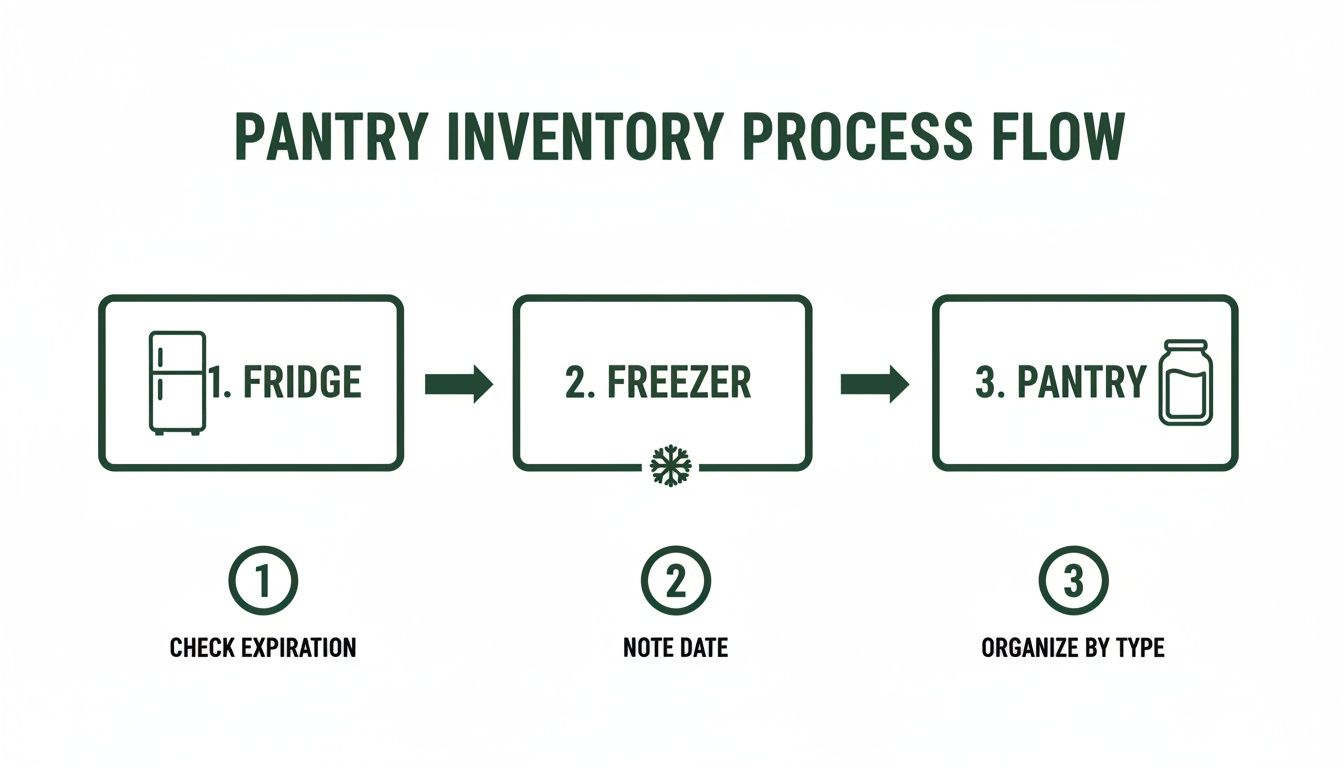
Starting your meal map this way forces you to build around what you already own, which is a total game-changer for your budget.
Get real about your energy levels, too. Slot in those quick, 20-minute meals for nights you know you'll be swamped. Save the more ambitious recipes for a lazy Sunday when you actually feel like cooking.
And please, for the love of all that is holy, plan for leftovers! Making a double batch of chili or soup on Monday means you have a ready-made, zero-effort lunch waiting for you on Tuesday. It’s a foundational habit, and you can dig deeper into it by learning how to plan weekly meals effectively.
Remember, your meal map isn't a contract set in stone. It's a flexible guide. If your Thursday plans go sideways, just swap it with Saturday’s meal. A good plan always has wiggle room.
To get the ball rolling, grabbing a free downloadable meal planner can give you a nice visual framework to start with.
When you map out your meals with intention—stacking ingredients, playing with themes, and planning for leftovers—you create the ultimate blueprint. This detailed plan is what transforms into a super-focused, categorized grocery list that gets you in and out of the store with exactly what you need. No more, no less.
Time to Build Your Aisle-by-Aisle Shopping List

Alright, you’ve mapped out your meals for the week. High five! Now, let's turn that brilliant plan into a grocery list that actually works with you in the store.
A random, jumbled list is your enemy. It’s a one-way ticket to a frustrating shopping trip, full of backtracking, forgotten items, and those sneaky impulse buys that always seem to jump into the cart. We're going to organize your list like a seasoned pro.
The secret is to structure your list to match the store's layout. Think about your path: you probably hit the produce section first, then swing by the bakery, grab what you need from the meat counter, then dairy, the inner aisles, and finish in the frozen section.
No more frantic zig-zagging across the store for a single forgotten onion! This strategy turns your shopping trip into a focused, get-in-get-out mission.
Build Your List by Store Category
Start by breaking your list into sections that mirror the grocery store's flow. This simple trick is the cornerstone of a killer meal planning grocery list. Your list should be a roadmap, not a chaotic treasure hunt.
Most grocery stores follow a pretty standard layout, so you can easily create a reusable template with these common categories:
- Produce: All your fresh fruits and veggies (e.g., 3 yellow onions, 1 bunch cilantro).
- Meat & Seafood: Anything from the butcher or seafood counter (e.g., 1 lb ground turkey, 2 salmon fillets).
- Dairy & Eggs: Milk, cheese, yogurt, and, well, eggs (e.g., 1 dozen eggs, 1 pint heavy cream).
- Pantry/Dry Goods: Canned goods, pasta, rice, snacks, spices (e.g., 28 oz can crushed tomatoes).
- Bakery: Fresh bread, tortillas, bagels.
- Frozen Foods: Frozen veggies, fruits, and anything else from the cold aisles.
Now, go through your meal map, recipe by recipe. As you do, slot each ingredient into its rightful category on your new, organized list. This method makes it nearly impossible to forget something and keeps you moving logically through the store.
Get Specific to Stop Wasting Money
This is where you can make a serious dent in your grocery bill. Instead of just scribbling "sour cream," get specific. If your taco recipe calls for one cup, write down "1 cup sour cream" or "8 oz container." This tiny detail is a game-changer.
Why? It stops you from mindlessly grabbing a giant tub that will inevitably grow a science experiment in the back of your fridge. You buy exactly what you need. Precision is your best friend in the war against food waste.
For anyone managing a household budget, this level of detail is a financial superpower. Precise grocery lists have been shown to slash overspending by 15-25%. That's a direct counterattack on the nearly $1,000 in food the average U.S. family throws out each year.
This is also where automation tools like Meal Flow AI can feel like magic, generating perfectly portioned lists that match your weekly prep and eliminate decision fatigue. If you're curious about the bigger picture, you can explore more insights on meal planning apps and their impact.
A specific list is a budget-enforcing tool. It removes guesswork at the store, so you're not tempted to grab the "family size" version of an ingredient when you only need a fraction of it.
Your final, polished grocery list is more than just a note on your phone. It’s the executable file for your entire week of meals. It guarantees a smooth, fast shopping trip and sets your meal prep up for total success.
Let a Robot Do the Shopping for You with Meal Flow AI
Alright, you’ve mastered the art of manual meal planning. You've become a pantry detective and an expert list-maker, navigating the grocery store like a pro. But what if you could put that entire, time-consuming process on autopilot?
This is where technology swoops in to save the day (and your sanity). Platforms like Meal Flow AI are built to do all that heavy lifting for you. They take the principles we've just walked through and use some serious smarts to whip up a personalized plan and a perfect meal planning grocery list in literally seconds.
Seriously, Let AI Do the Hard Work
Think about it for a second. Instead of manually checking what's in the cupboard, trying to remember if little Timmy still hates broccoli, and cross-referencing sale flyers, the system just does it. It juggles your dietary restrictions, knows what you already have, and can even factor in local sales to build the most efficient plan imaginable.
This is the ultimate shortcut for anyone who’s ever felt the Sunday Scaries creep in. The AI can dream up a week's worth of meals your family will actually get excited about, and it spits out a shopping list that’s already organized for you.
The real game-changer? Turning that plan into actual food in your fridge with a single click. Meal Flow AI hooks up with services like Instacart, meaning your AI-generated list gets zapped over for delivery. You can completely skip the store.
This isn't just about being lazy (though there's no shame in that!). It’s about getting hours of your life back every single week. The whole cycle—planning, shopping, and getting groceries to your door—becomes one smooth, automated motion. If you want to dive deeper, check out our guide on finding the best menu planner and shopping list app to fit your life.
From Your Screen to Your Doorstep
The whole thing is refreshingly simple. Once the AI has created your weekly meal plan, it pulls together every last ingredient into a shopping list, all sorted by category. You give it a quick once-over, swap anything you want, and then—bam!—send it straight to Instacart.
It’s as easy as this:
- Tell It What You Like: Plug in your family's dietary needs, favorite foods, and budget.
- Get Your Plan: The AI instantly generates a week of recipes and the grocery list to match.
- Click to Order: The list flies over to Instacart, where a personal shopper does the legwork.
- Kick Back & Relax: Your groceries show up right at your door, ready for a week of delicious, stress-free cooking.
This combination of smart planning and on-demand delivery turns meal prep from a dreaded weekly chore into a task you can knock out in minutes.
Got Questions About Meal Planning? I've Got Answers.
Even with a killer system, a few questions always pop up when you're trying to nail down your grocery list game. It's totally normal. Let's tackle the most common ones that throw people for a loop, so you can skip the guesswork and get right to the good part: eating!
Think of this as your expert-led troubleshooting session. We'll smooth out the wrinkles in your process and get you on your way to meal-planning glory.
How Far in Advance Should I Actually Plan My Grocery List?
For most of us, the magic number is one week. Planning for seven days at a time just hits the sweet spot. Why? For starters, it lets you pounce on the weekly sales flyers. You can literally build your menu around what’s cheapest at the store that week.
A one-week plan is also incredibly flexible. Let's be real, life happens. A friend calls for a last-minute dinner out, or you get stuck late at work and order a pizza. Derailing a seven-day plan is no big deal; derailing a month-long plan feels like a catastrophic failure.
Plus, and this is a big one, it means you buy fresh produce you'll actually use before it turns into a science experiment in your crisper drawer. A month-long plan might sound impressive, but it's usually just a one-way ticket to wasted food and a whole lot of stress.
What's the Best Way to Handle Snacks and Lunches?
This is where the wheels fall off for so many people. Instead of overthinking it and scheduling every single apple slice, think in categories. I call it the "snack station" approach. On your list, just add a category for snacks and aim to grab three or four easy options for the week.
- Fresh & Fast: A bunch of bananas, a bag of apples, or a pint of washed grapes.
- Protein Power: Individual Greek yogurts, string cheese, or a dozen hard-boiled eggs.
- Pantry Grabs: A box of your favorite granola bars or a bag of trail mix.
When it comes to lunches, your new best friend is the planned leftover. Seriously. As you map out your dinners, deliberately choose two or three meals that are just as good—or even better—the next day. We're talking chili, big pots of soup, or a hearty pasta bake. You cook once and eat twice. It's the ultimate kitchen hack.
How Do I Stick to My List and Stop Impulse Buying?
Ah, the siren call of the cookie aisle. I feel you. The number one rule is a classic for a reason: never, ever shop hungry. It’s a scientifically proven way to end up with a cart full of stuff you don’t need and a budget you just blew.
Your best defense is a well-organized, aisle-by-aisle list. It gives your shopping trip a clear mission. You're not wandering; you're executing a plan, which leaves way less time for that shiny new flavor of potato chips to catch your eye.
If you’re shopping in person, here’s a trick I love: give yourself a small "wild card" budget. Maybe it’s $5 or $10. If you see something totally random that you want, you can get it—but only if it fits in that pre-approved slush fund. It gives you a little freedom without torpedoing your whole budget.
---
Ready to put your grocery list on autopilot? **Meal Flow AI** generates personalized meal plans and sends your perfectly organized shopping list straight to Instacart. Stop planning and start cooking. Get your first meal plan in seconds at Meal Flow AI.