A Stay At Home Mom Daily Schedule That Actually Works
Tired of chaos? Learn how to create a flexible stay at home mom daily schedule that balances chores, kids, and your own sanity. Real tips and templates inside.
Love This Article?
Get personalized meal plans with recipes like this, automatically matched to your nutrition targets.
A realistic stay at home mom daily schedule isn't about those color-coded, minute-by-minute charts that make you feel like a failure by 9 AM. Forget that. The real secret is creating a flexible rhythm that keeps the chaos at bay.
You build this rhythm around a few non-negotiable "anchor points"—think meals, naps, and bedtime. These are your guideposts. They provide just enough structure to keep the day from spiraling, while leaving plenty of room for the beautiful, messy, and utterly unpredictable reality of life with kids. It’s how you stay sane and feel in control, even when the day goes completely sideways.
Escaping The Pinterest-Perfect Schedule Myth

First things first, let's have a real talk about those "perfect" schedules you see plastered all over social media. They're a fantasy. It's time to release yourself from the pressure to live up to some influencer’s impossible standard and instead, create a routine that actually works for your family.
The honest truth? Life with children is messy. It's unpredictable. And it almost never fits neatly into 30-minute time slots. A rigid schedule just sets you up for frustration and guilt when—not if—a toddler tantrum, a surprise diaper explosion, or an all-out nap strike throws a wrench in your plans.
Embracing a Flexible Framework
So, instead of a strict itinerary, think of your schedule as a loose, flexible framework built around a few key "anchor points." These are the handful of things that are pretty much guaranteed to happen every day, giving your family a predictable and comforting rhythm.
What are anchor points, exactly? They're the big, important rocks you place in your jar first. Everything else just fills in around them.
- Meal Times: Breakfast, lunch, and dinner are natural, non-negotiable breaks in the day.
- Nap and Bedtimes: These are sacred. They’re crucial for your kids' well-being and, let's be honest, your own sanity.
- School Pick-up/Drop-off: If you have older kids, these are fixed points in your day you have to work around.
By focusing on just these few anchors, you create a simple, reliable flow. The time between these events can stay fluid. That’s your space for spontaneous park trips, epic living room dance parties, or just tackling the mountain of laundry without feeling like you've failed your schedule. This whole approach is the key to figuring out how to stick to a routine when you’re living in the real world, not a spreadsheet.
To get started, try mapping out your own family's anchors. This simple exercise helps you see the basic structure of your day before you even start filling in the details.
Identifying Your Family's Daily Anchor Points
| Time of Day | Anchor Point (e.g., Breakfast) | Flexibility Level (Low/Medium/High) | Notes (e.g., Kid's Mood) |
| Morning | Breakfast | Low | Everyone is usually hungry and happy. |
| Mid-Morning | Toddler Nap | Low | Crucial! Don't mess with naptime. |
| Afternoon | School Pick-Up | Low | Time is fixed, can't be late. |
| Afternoon | Lunch | Medium | Can be shifted by 30 mins if needed. |
| Evening | Dinner | Medium | Family meal, but time can vary a bit. |
| Evening | Bedtime Routine | Low | Predictability helps kids wind down. |
Once you have your anchors down, the rest of the day feels much more manageable. You’re not trying to dictate every moment, just guiding the flow from one predictable point to the next.
The goal isn't to control every minute of your day. It's to create a reliable rhythm that reduces decision fatigue and provides a sense of calm for both you and your children.
This need for a solid home-front rhythm has become more important than ever. Back in the 1950s, 84% of mothers were stay-at-home, a number that changed dramatically over the following decades. But we're seeing a fascinating shift back, with projections suggesting nearly 25% of mothers will be stay-at-home by 2025. It’s clear that finding effective ways to manage the household is once again a major focus for families everywhere.
Let's Be Real About "Time Blocking" When You're a Mom
The term "time blocking" probably conjures up images of a tech CEO with a color-coded calendar scheduling every second for "synergy" and "optimization." Let's be honest, that's not our reality. For a stay-at-home mom, a rigid, minute-by-minute schedule is a one-way ticket to frustration city.
So, let's steal the concept but make it work for us. Forget scheduling "9:00-9:30 AM: Unload dishwasher." That's just setting yourself up for failure. Instead, we're going to think in flexible "modes."
Picture this: instead of a tiny, rigid time slot, you create a big, forgiving block of time called "Household Hustle." This is your window for general tidying, throwing in a load of laundry, or starting some meal prep. If one task bleeds into another, who cares? You're still in the right "mode," and the day doesn't feel like it's completely off the rails.
So, How Do You Build These Blocks?
The real genius here is grouping similar tasks together. This is a game-changer and a core principle of good time management for moms because it stops you from constantly switching gears, which is mentally exhausting. Your day might just break down into a few simple, powerful blocks.
Here are a few I've come to rely on:
- Kid Focus Time: This is sacred. It's for getting on the floor to play, reading that same book for the tenth time, or making a glorious mess with a craft project. Your phone is out of sight, and your attention is 100% on them.
- Independent Play: The holy grail! This is the block where the kids are happily occupied, giving you a precious window to do something else nearby. Maybe you fold laundry while they build a block tower or answer emails while they're deep into their sticker books.
- Household Hustle: Time to put on a podcast and get to it. This is your power-hour (or half-hour) for chores. Attack the kitchen, run the vacuum—whatever needs doing.
- Mom’s Timeout: Do not skip this block. I repeat: DO NOT SKIP THIS BLOCK. This is non-negotiable time for you. Even if it's just 15 minutes to sit in silence with a hot cup of coffee, it's the reset you need.
When I first tried a super-strict schedule, it was an epic fail. I had "Snack Time" penciled in for 10:15 AM sharp, but my toddler, of course, had a full-blown meltdown at 10:10. The whole day felt shot. The lightbulb moment was switching to these big, forgiving blocks. The beautiful chaos of life with little kids just doesn't fit neatly into a spreadsheet.
A block schedule isn't about controlling every minute. It’s about creating intentional zones for the different hats you wear all day. The schedule adapts to your life, not the other way around.
This approach gives you a framework and a sense of purpose without the crushing pressure of a minute-by-minute agenda. And as your kids get older, you can even get them in on the action. This complete parent guide to time management for kids has some great ideas for teaching them about routines, which helps your own blocks run that much smoother. It's all about finding a rhythm that works for your unique family, making your days feel less like a frantic reaction and a whole lot more peaceful.
How to Customize Your Schedule for Any Age
Let's be real: the killer stay at home mom daily schedule that works wonders for a sleepy newborn is a recipe for absolute disaster with a wild-eyed kindergartener. Kids change so fast, and our daily rhythm has to keep up. Think of your schedule less as a carved-in-stone tablet and more as a living, breathing guide that adapts to each new, chaotic, beautiful stage of motherhood.
The secret is to tune into the core needs of each age group and build your day around them. This is how your routine becomes a safety net instead of a straightjacket that no longer fits your family.
The Infant Stage: Eat, Play, Sleep, Repeat
With a baby, life is a beautifully simple cycle: Eat, Play, Sleep. Your entire schedule should flow with this natural rhythm. Fighting it is a one-way ticket to Frustration-ville for both of you.
- Eat: Feeding times are your new North Star. Everything else revolves around them.
- Play: This is the sacred "wake window." It's your time for tummy time floor parties, silly songs, and introducing them to the crinkly sound of a toy elephant.
- Sleep: Naps are frequent, non-negotiable, and absolutely vital for their little growing brains.
The goal isn’t to watch the clock like a hawk but to follow their cues within this sequence. If you're looking to create more predictable chunks of time (and who isn't?), you might want to look into different strategies on how to sleep train a baby.
The Toddler Years: Juggling Structure and Glorious Chaos
Toddlers are tiny tornadoes of pure energy and boundless curiosity. A winning schedule for this age brings in a bit more structure while leaving plenty of room for them to explore and, let's be honest, make a mess. Your time blocks will naturally get a little longer and more defined.
This is the perfect time to introduce concepts like "quiet time" (even if they've sworn off naps), simple learning activities like puzzles or coloring, and dedicated outdoor time to burn off that incredible energy. Independent playtime becomes your best friend, giving you precious windows to tackle chores while they're safely occupied nearby.
A simple way to think about this is dividing your day into different "modes" to keep things organized but flexible.
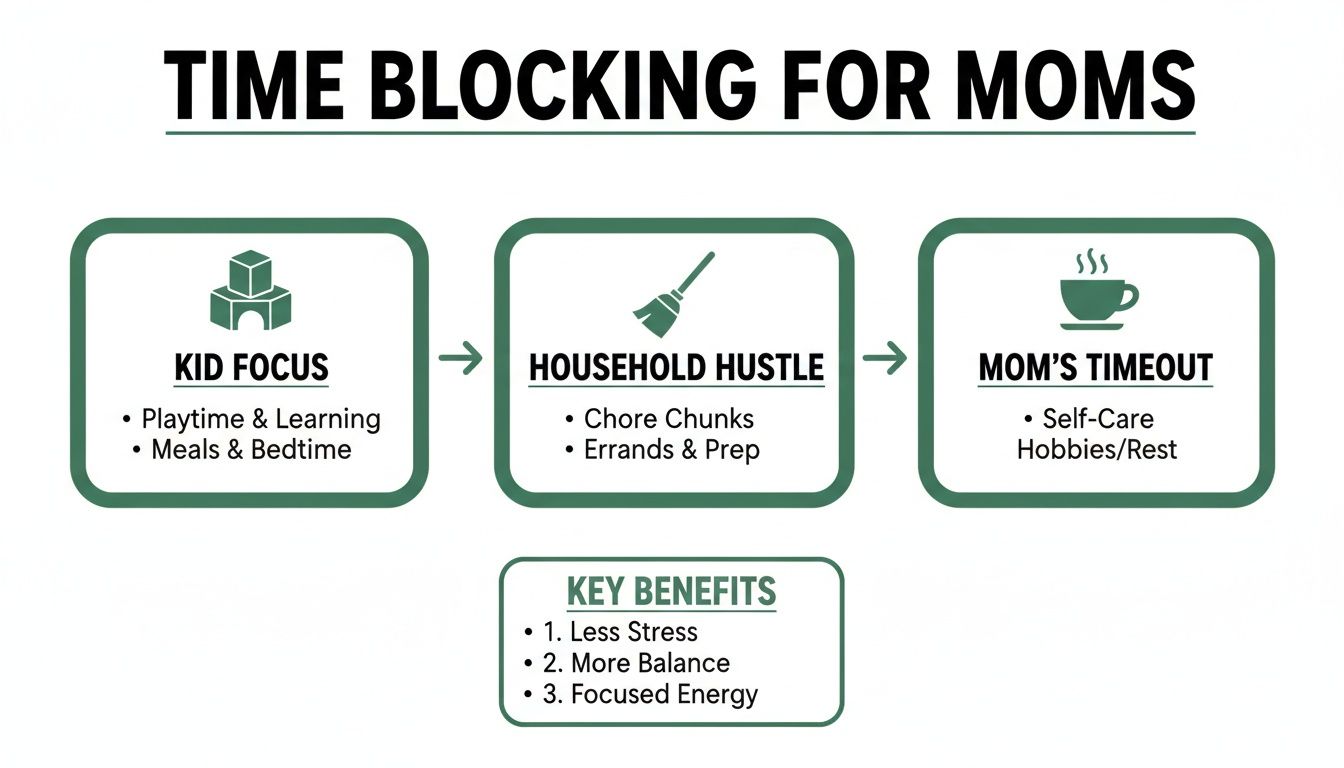
This mental shift helps you flow from one activity to the next without feeling chained to a minute-by-minute timeline.
School-Aged Kids: The After-School Hustle
Once the kids are in school, your whole world shifts on its axis. The school bell, soccer practice, and homework battles are your new anchor points. The real challenge becomes taming the infamous "after-school chaos."
Create a consistent after-school routine: snack, a bit of downtime, then homework. This predictability helps kids decompress and transition from the structured school day back to home life without a major meltdown.
Your personal time is now concentrated during school hours, which is prime time for your own appointments or what I like to call the "Household Hustle."
As kids get older, the demands on your time just change form. It's fascinating, really—research shows that stay-at-home mothers of children under 5 have about four fewer hours of leisure time per week than moms of school-aged kids. It just goes to show how critical these age-specific strategies are for your own well-being.
To give you a clearer picture, here’s a look at how those daily blocks might change as your little ones grow.
Sample Schedule Blocks by Child's Age
| Time Block | Infant (0-12 months) | Toddler (1-3 years) | School-Age (5+ years) |
| Morning | Feed, Play (tummy time), Nap 1 | Breakfast, Get Dressed, Learning Play | School Drop-off, Household Hustle |
| Mid-Day | Feed, Play (walk), Nap 2 | Lunch, Outdoor Play, Quiet/Nap Time | Mom's Work/Errands, Lunch Prep |
| Afternoon | Feed, Play, Short Nap 3 | Snack, Independent Play, Arts & Crafts | School Pick-up, Snack, Downtime |
| Evening | Feed, Bath, Bedtime Routine | Dinner, Family Time, Bedtime Story | Homework, Dinner, After-School Activity |
Of course, this is just a starting point! Your family's version will look different, and that's exactly how it should be. The goal is to have a framework that serves you, not the other way around.
Winning the Day with Smart Meal Planning

It’s the question that can completely shatter the calm of a perfectly good day: “What’s for dinner?”
That single thought, usually creeping in around 4 PM, has the power to derail your whole evening. What was a peaceful wind-down suddenly turns into a frantic scramble through the fridge and pantry. Honestly, weaving smart meal planning into your routine is one of the biggest game-changers for any stay at home mom daily schedule.
This isn't about becoming a gourmet chef or being chained to the stove all Sunday afternoon. It's about taking back your precious mental energy. The endless decision-making is what truly exhausts us, and planning meals ahead of time takes one of the biggest daily decisions right off your plate.
The Magic of Theme Nights
The easiest way to dip your toes into meal planning is with the glorious, sanity-saving concept of theme nights. This simple trick gives your week a bit of structure without boxing you in, making the "what to cook" question practically answer itself.
Your theme nights can be whatever your family loves. The goal is just to create a predictable, easy-to-follow rhythm.
- Meatless Monday: A perfect excuse for simple pasta dishes, hearty bean chili, or loaded veggie quesadillas.
- Taco Tuesday: A classic for a reason! It’s fun, everyone can build their own, and the actual cooking is minimal.
- "Brinner" Wednesday: Breakfast for dinner is always a win. Who can say no to pancakes or scrambled eggs in the evening?
- Pizza Friday: Whether it's homemade, frozen, or from your favorite local spot, it’s the perfect low-stress way to kick off the weekend.
Once you have your themes, filling in the menu is a breeze. You’re not staring at a blank slate every day—you’ve got a starting point.
Your Sunday Prep Power Hour
A little bit of prep work over the weekend feels like a gift you’re giving your future self all week long. You don't have to cook every single meal from start to finish. Instead, focus on the little tasks that make weeknight cooking feel less like a monumental chore.
Just set aside one hour on Sunday. Put on some music or a podcast and knock out a few simple things.
- Chop the Veggies: Get those onions, bell peppers, and carrots washed, chopped, and stored in containers in the fridge.
- Cook Your Grains: Make a big batch of rice or quinoa to have on hand for easy side dishes or grain bowls.
- Prep Your Protein: Brown the ground beef for Taco Tuesday, marinate the chicken for Thursday, or hard-boil some eggs for quick snacks.
By front-loading just a little bit of the work, you get rid of that daily friction of starting from scratch. You’re not just prepping food; you’re buying back time and patience for those chaotic weeknights.
Of course, the act of meal planning can sometimes feel like just another thing on the to-do list. The good news is that modern tools can do the heavy lifting for you. For a deeper look at making this almost effortless, check out our guide on meal planning for busy moms. It dives into how you can automate everything from finding recipes to writing your grocery list.
Platforms like Meal Flow AI can whip up personalized meal plans based on what your family actually likes to eat and create an instant shopping list. Suddenly, a multi-step chore becomes a few simple clicks. This isn't just about food; it's about building a smarter, more efficient system that makes your whole day run smoother.
How to Handle Interruptions and Find Time for You

Let's get real for a second. No schedule, no matter how beautifully color-coded, can survive a toddler discovering the joy of unspooling an entire roll of toilet paper, a surprise stomach bug, or the dog deciding to roll in something unspeakable. Life with kids is gloriously unpredictable.
The secret isn’t creating a rigid, unbreakable schedule. It's about designing one that can bend when life throws a curveball, without completely shattering your sanity.
On days when the universe seems to be conspiring against you, clinging to your original plan is just asking for a meltdown. Instead of waving the white flag, you need a simple, powerful tool to get back in the driver's seat.
Your Secret Weapon: The "Must-Do Three"
When the morning is already a dumpster fire, just pause. Take one deep breath and ask yourself this single, game-changing question: "If I only get three things done today, what will make the biggest positive impact?"
Welcome to your Must-Do Three. This is your emergency triage system for a chaotic day.
This isn’t about being a productivity ninja; it’s about protecting your peace of mind. Your three things might be ridiculously simple, and that's the point.
- Keep the tiny humans fed.
- Run one load of laundry so there are clean jammies for tonight.
- Read one book together without interruptions.
That’s it. Everything else—the crumb-covered floors, the mountain of toys, the gourmet dinner you planned—can wait. By zeroing in on just three achievable goals, you can end a completely bonkers day feeling like you actually accomplished something, instead of feeling like a total failure.
The 'Must-Do Three' isn't a to-do list; it's a permission slip. It gives you permission to let go of the non-essentials when your day demands all your focus and energy elsewhere.
This is how you learn to roll with the punches. It’s a vital skill for making any routine sustainable in the long run.
Finally Finding Time for Yourself (Without the Guilt)
What's the very first thing to get axed from the schedule when things get hairy? Yep. "Me time." We convince ourselves it's a luxury, an indulgence we can't afford. But that’s a lie we need to stop telling ourselves.
Making time for yourself isn't selfish; it's a non-negotiable part of being a patient, present, and happy mom. Think of it this way: your well-being is the engine that keeps this whole family train running.
This is more critical now than ever. The demands on mothers have skyrocketed. One analysis found that a stay-at-home mom in 2000 spent seventeen hours a week on child-centered activities—that's a staggering 70% increase from 1965! With that kind of pressure, burnout is practically a given. You can dig into some fascinating insights on modern motherhood to see just how much the landscape has changed.
The key is to start hunting for tiny, bite-sized pockets of time. We're not talking about two-hour bubble baths or weekend spa trips (though, if you can get one, go for it!). We're talking about micro-breaks that can genuinely recharge your battery.
- The Nap Time Ten: The second that baby is asleep, don’t leap into chores. Sit down. Have a hot cup of coffee. For ten minutes. That's it.
- The Driveway Decompress: After a chaotic trip to the grocery store, before you even unbuckle the car seats, turn on your favorite song and just breathe for a solid three minutes.
- The Podcast Escape: Pop in one earbud and listen to a chapter of an audiobook or a funny podcast while you're folding laundry or tackling that mountain of dishes.
Actively scheduling these little moments, no matter how small they seem, sends a powerful signal to your brain: my needs matter, too. That, right there, is the foundation of a stay-at-home mom schedule that actually works—one that takes care of everyone, especially you.
Still Have Questions? Let's Talk.
Okay, so you've got the framework for a killer stay-at-home mom schedule. But let's be real—life with kids is messy, and a pretty template doesn't solve every problem. This is where we get into the nitty-gritty, the "what if" scenarios that can send even the most organized plan into a tailspin.
Let’s tackle some of the most common questions I hear.
"My Baby's Naps Are All Over the Place. How Can I Stick to a Schedule?"
Ah, the unpredictable nap. It's the ultimate schedule-wrecker for moms with little ones! Here’s the secret: stop watching the clock and start watching your baby.
Instead of aiming for a rigid "1 PM nap," shift your focus to a flexible "wake window" routine. This means you kick off your pre-nap ritual a set amount of time after they wake up, no matter what time that is.
Your routine could be as simple as:
- Lunch
- A quick, quiet story in your rocking chair
- Singing their favorite lullaby as you close the blinds
This creates a powerful sleep cue for your baby, making naptime feel predictable even when the clock says otherwise. And for those days when the nap just doesn't happen? Don't panic. Have a backup plan with some quiet, independent activities (think sensory bins or a special basket of toys) to keep them occupied.
The goal isn't to force a nap at a specific time. It's to create a calm, predictable wind-down that signals to your child's brain, "Hey, it's time to rest now." That consistency is pure magic.
"How Do I Get My Partner on Board with This New Schedule?"
This one is huge. The last thing you want is for your new schedule to feel like a set of rules you're forcing on everyone. The key is to frame it as a team effort, not a top-down decree.
Find a time to sit down together—without the TV on or phones in hand—and walk them through it. Explain how having a plan can reduce stress for both of you and create more intentional family time.
Ask for their input directly, especially on the parts of the day where they’re most involved, like mornings, evenings, and weekends. When you clearly define who's handling what during those chaotic "witching hours," you'll cut down on so much friction. Once they see how much smoother the household runs, they'll be your biggest fan.
"My Perfect Schedule Falls Apart by Tuesday. What Am I Doing Wrong?"
First off, you're not doing anything wrong! A schedule that implodes before hump day is almost always a sign of one thing: it’s too dang ambitious. We all do it—we cram our days with a to-do list a mile long with zero breathing room for a toddler tantrum or a surprise phone call.
The fix? Simplify. Radically.
For one week, try this: schedule only your non-negotiable anchor points (meals, naps, school runs) and one single "must-do" task each day. That’s it. Anything else you get done is a win. This helps you lock in a core rhythm that actually feels manageable. Once that feels like second nature, you can slowly start adding one or two more things back in. Remember, the goal is sustainable progress, not immediate perfection.
"How Do I Build in Time for Myself Without Feeling So Guilty?"
Let's get one thing straight: taking a break isn't a reward you have to earn. It's a non-negotiable part of being a good mom. You have to schedule it with the same seriousness as a pediatrician's appointment, otherwise, it will get pushed to the bottom of the list every single time.
Start small, but be specific. We're not talking about a weekend spa getaway (unless you can swing it!).
Think tinier, more accessible breaks:
- 15 minutes of reading in the car after you've loaded the groceries, before you go inside.
- A solo walk around the block the second your partner walks through the door.
- A hot bath with the door locked after the kids are finally asleep.
When you physically write these moments into your schedule, you're telling yourself they matter. You can't pour from an empty cup, mama. Recharging your own battery is what gives you the energy to show up as the patient, present parent you want to be.
---
Ready to take the stress out of mealtimes for good? At Meal Flow AI, we use smart technology to create personalized meal plans your family will love and send the grocery list straight to Instacart. Stop asking "what's for dinner?" and start enjoying more time with your family by visiting https://mealflow.ai today.